If you’ve typed a question into ChatGPT lately and quietly wondered whether you’re still using the best tool available — you’re not alone. The AI landscape has shifted dramatically, and what felt like a clear winner just a couple of years ago now faces serious competition from every direction. Is ChatGPT still the best AI in 2026? That’s a question more creators, marketers, and small business owners are asking as new models roll out almost monthly.
ChatGPT remains powerful, but it’s no longer the obvious default for every task — here’s where it still dominates and where newer alternatives genuinely outperform it.
Key Takeaways
- ChatGPT remains powerful for general tasks, but specialized AI tools now outperform it in specific domains like content creation and technical writing.
- Content creators should evaluate ChatGPT against dedicated writing tools that offer superior formatting, SEO optimization, and industry-specific features.
- Pricing varies significantly across AI platforms; ChatGPT isn’t always the cheapest option when factoring in specialized tool subscriptions.
- Best AI choice depends entirely on your primary use case, budget constraints, and whether you need general versatility or specialized capabilities.
- Decision framework should weigh ChatGPT’s accessibility against emerging competitors offering better performance for niche applications and professional workflows.
In This Article
- The Short Answer: It Depends on Your Needs
- What ChatGPT Does Well in 2026
- Where ChatGPT Falls Short for Content Creators
- Best AI Writing Tools for Your Use Case (2026)
- Pricing & ROI: Is ChatGPT Cheaper?
- The Verdict: ChatGPT vs. Specialized AI Tools
- How to Choose Your AI Writing Tool (Decision Framework)
- Ready to Find Your AI Match?
The Short Answer: It Depends on Your Needs
Let’s get the honest take out of the way first: ChatGPT is still one of the best AI tools available in 2026 — but “best” is doing a lot of heavy lifting in that sentence. The reality is that no single AI tool dominates every use case, and the gap between the top players has narrowed significantly over the past year.
Think of it this way. If you’re a marketer who needs long-form content with strong brand voice, your ideal tool might look very different from what a small business owner needs for customer support automation, or what a freelance designer needs for creative brainstorming. The AI that earns the title of “best” shifts depending on the job you’re hiring it to do.
Here’s a simple way to think about the current landscape:
- Conversational depth and reasoning: ChatGPT still holds its own here, especially with the latest GPT-4o model.
- Long-form content and marketing copy: Specialized writing tools have pulled ahead in meaningful ways.
- Image generation and multimodal tasks: The competition is fierce and genuinely strong.
- Workflow integration and automation: Several challengers have built purpose-built features that ChatGPT doesn’t prioritize.
So rather than declare a single winner, this article uses a practical framework: we’ll look at what ChatGPT does better than anyone else, where it falls short, and which alternatives are worth your attention depending on your specific goals. That way, you can make an informed decision — not just follow the hype.
What ChatGPT Does Well in 2026
Despite the crowded field, ChatGPT remains the most widely adopted AI tool in the world — and that’s not just brand recognition carrying it. The product has genuinely evolved. The current GPT-4o model handles text, images, and voice in a single interface, making it one of the most versatile options available to everyday users.
Here’s where ChatGPT consistently delivers:
- Conversational reasoning: It handles nuanced, multi-step questions better than most tools at a similar price point.
- Multi-modal input: You can upload images, speak directly to it, and get responses that blend all three formats naturally.
- Free tier access: A capable free version still exists, which keeps it accessible to users who aren’t ready to commit to a paid plan.
- Broad knowledge base: It covers an enormous range of topics without requiring you to install plugins or switch contexts.
- Custom GPTs: You can build or use pre-made versions tuned for specific tasks, which adds meaningful flexibility.
The voice mode, in particular, has become surprisingly useful for people who want to think out loud or get quick answers without typing. It’s not perfect, but it’s polished enough to use in real workflows.
Why Creators Still Use It
For content creators and marketers, ChatGPT earns its place as a reliable starting point. It’s especially strong when you need to move fast — whether that’s generating a rough draft, brainstorming ten headline variations, or getting a quick research summary before a client call.
Common real-world use cases include:
- Drafting blog post outlines and first drafts for editing
- Repurposing long-form content into social media snippets
- Researching unfamiliar topics quickly before writing
- Editing and tightening existing copy for clarity and tone
- Generating creative angles when you’re stuck on a concept
The key word there is starting point. Most experienced creators use ChatGPT to remove the blank page problem, then refine the output themselves. It accelerates the process without replacing the human judgment that makes content actually resonate with an audience.
Where ChatGPT Falls Short for Content Creators
ChatGPT is genuinely impressive, but it’s a generalist tool built for a wide audience — and that’s exactly where its limitations start to show. If you’re a content creator, marketer, or small business owner with specific, recurring production needs, you’ll likely bump into a few frustrating gaps fairly quickly.
Here’s where the cracks tend to appear:
- No built-in SEO optimization: ChatGPT doesn’t analyze search intent, suggest keyword placement, or score your content against ranking factors. You’re on your own when it comes to making content search-friendly.
- Inconsistent brand voice: Unless you paste in detailed instructions every single session, ChatGPT won’t remember your tone, style preferences, or brand guidelines from one conversation to the next.
- No content calendar integration: There’s no native way to plan, schedule, or track content production inside ChatGPT. It’s a writing assistant, not a workflow tool.
- Limited template structure: For creators who rely on repeatable formats — product descriptions, email sequences, ad copy — rebuilding prompts from scratch each time gets old fast.
None of these are dealbreakers if you’re using ChatGPT occasionally. But if content is central to your business, these gaps add up.
The Volume Problem
Here’s where things get particularly challenging. ChatGPT works well when you need one solid piece of content. It starts to feel clunky when you need fifty. There’s no batch creation mode, no built-in brief templates, and no way to maintain consistent quality across a high volume of assets without a lot of manual prompt management.
For solo creators, that’s manageable. For marketing teams or agencies producing content at scale — think 50 or more pieces per month — it becomes a real bottleneck. This is precisely where specialized AI writing tools are designed to shine. They’re built around repeatable workflows, brand consistency, and production speed in ways that a general-purpose chatbot simply isn’t. That’s not a knock on ChatGPT — it’s just not what it was designed for.
Best AI Writing Tools for Your Use Case (2026)
If ChatGPT’s limitations are slowing you down, the good news is that a new generation of specialized AI writing tools has stepped in to fill the gaps. Each of the three tools below solves a specific problem that ChatGPT wasn’t built to handle — whether that’s brand consistency, ease of use for beginners, or built-in SEO. The right choice depends on how you work and what you’re trying to produce.
For Marketing Teams: Jasper AI AI
If you’re running a marketing team or agency, brand voice consistency is everything. Jasper AI was built with this in mind — it lets you train the tool on your brand guidelines so every piece of output sounds like you, not a generic AI. That’s a meaningful advantage when you’re managing multiple writers or clients.
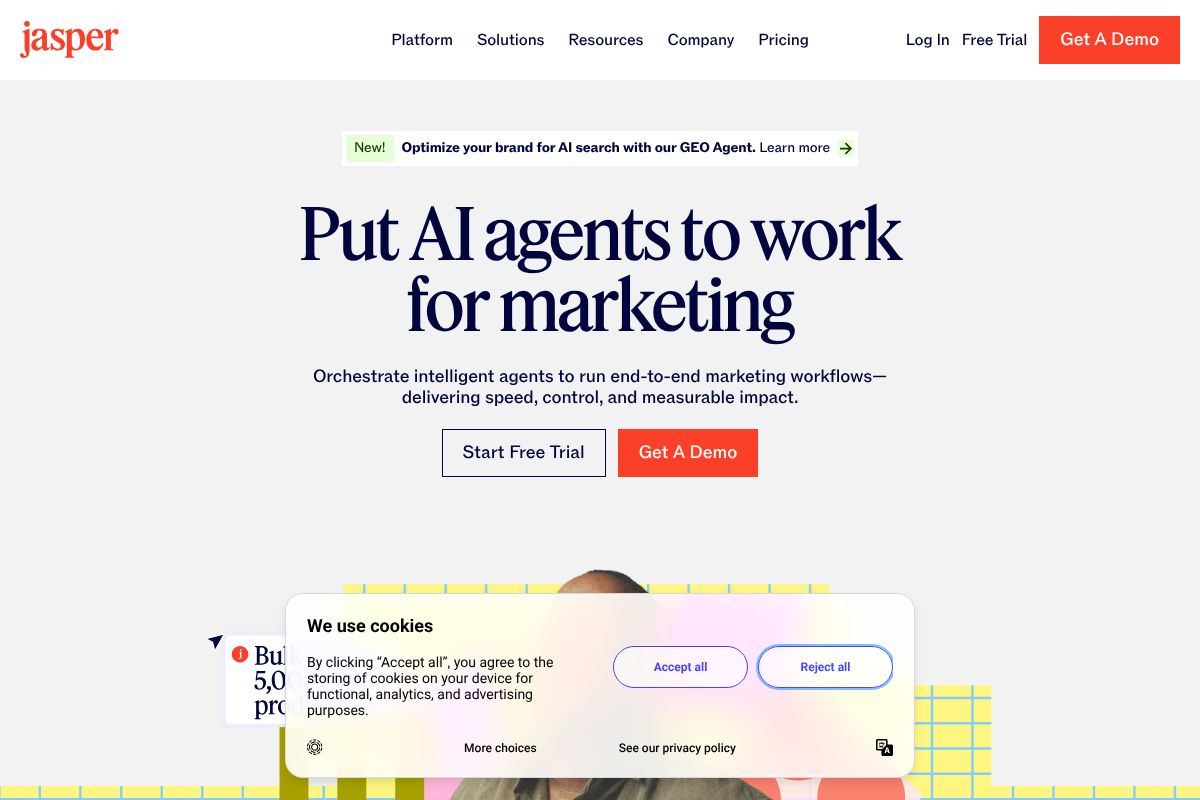
Jasper also supports real team collaboration, with shared workspaces, user roles, and campaign-level organization. For high-volume content production, that structure matters.
- Plans: Creator at $49/month, Pro at $69/month, Teams at $125/month
- Best for: Agencies, in-house marketing teams, brand-heavy content
- Key advantage over ChatGPT: Persistent brand voice and team workflows
For Solo Creators & Small Biz: Copy.ai
Copy.ai is one of the most accessible AI writing tools available right now, and the free tier makes it genuinely easy to try before you commit. The interface is clean and beginner-friendly — you don’t need to be a prompt engineer to get useful output.
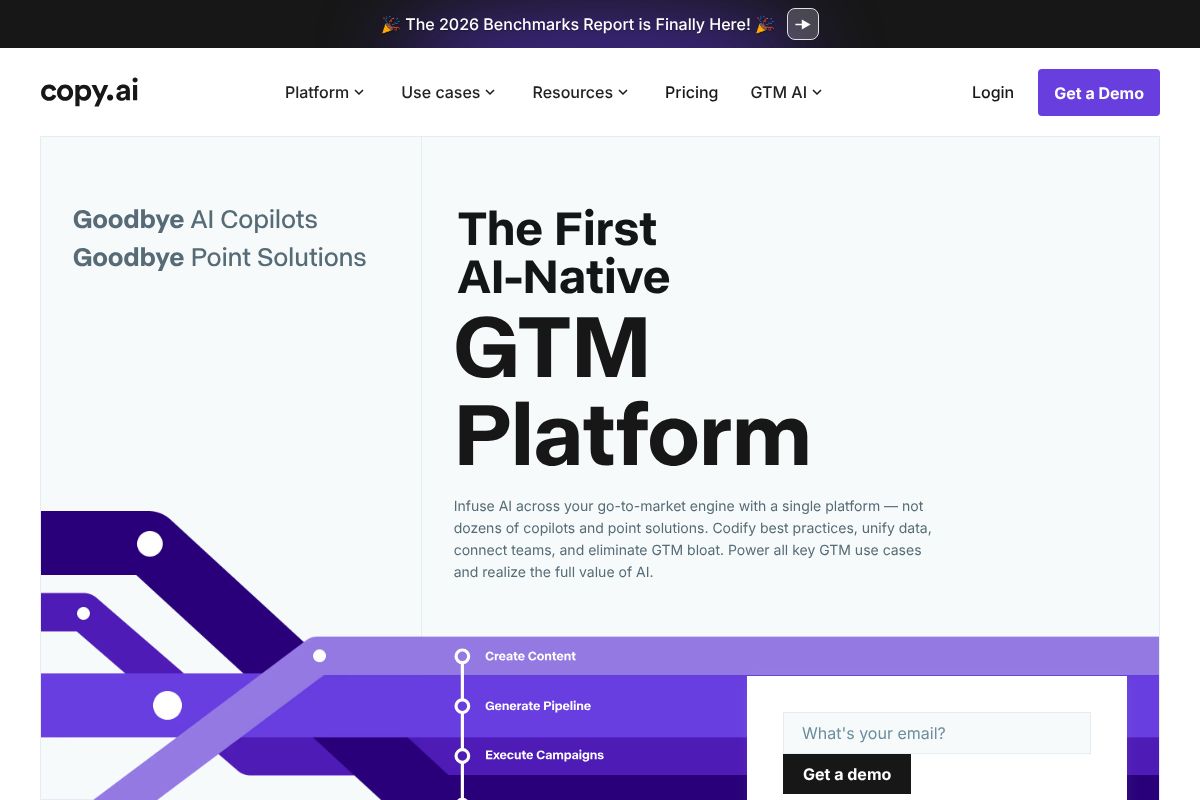
For freelancers and solopreneurs who need a flexible, low-risk way to start integrating AI into their workflow, Copy.ai is a smart starting point. Paid plans scale with your needs without a steep jump in complexity.
- Plans: Free tier available; paid plans from $29 to $249/month
- Best for: Freelancers, solopreneurs, small business owners
- Key advantage over ChatGPT: Ready-made templates and a structured interface that removes guesswork
For SEO-Focused Bloggers: Writesonic
Writesonic stands out because it combines AI writing with built-in SEO optimization — something ChatGPT simply doesn’t offer natively. If organic search traffic matters to your business, having keyword targeting and content planning baked into your writing tool saves significant time.
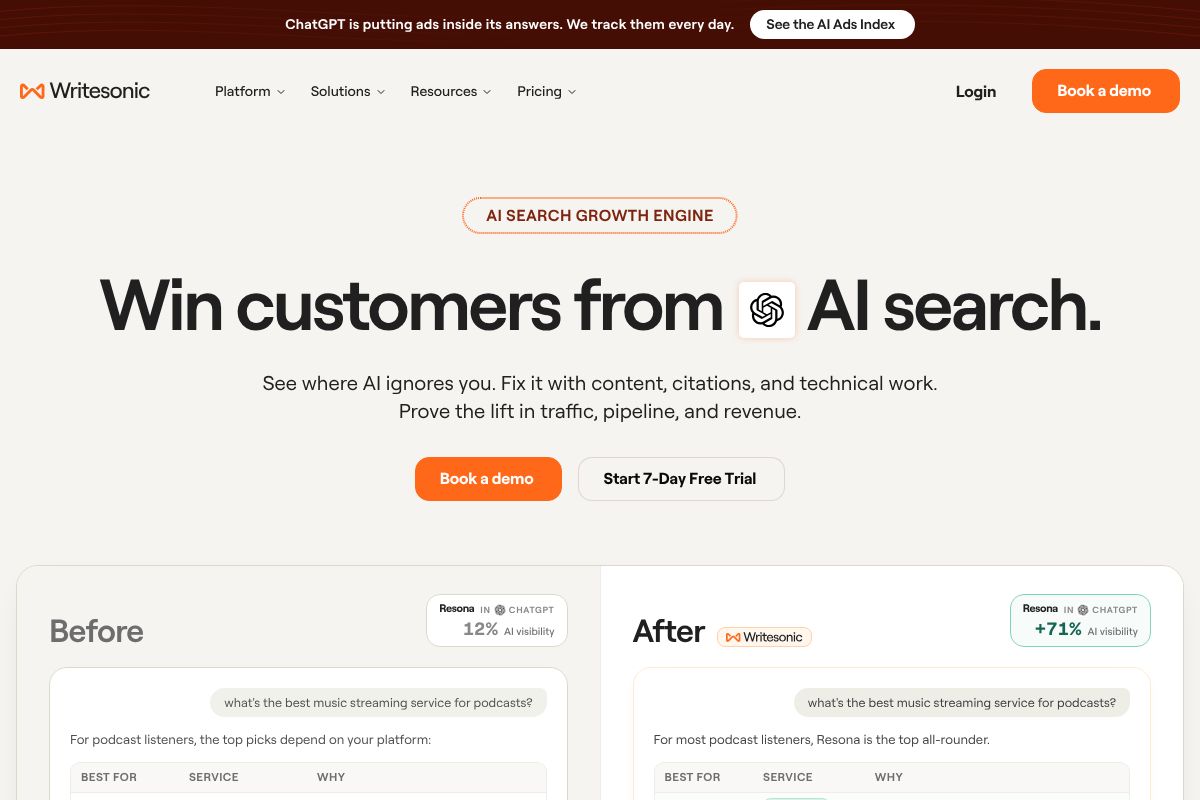
It’s particularly well-suited to bloggers who want to plan, draft, and optimize content inside a single platform rather than juggling separate tools.
- Plans: $39 to $99/month depending on usage
- Best for: Bloggers, content marketers focused on search visibility
- Key advantage over ChatGPT: Integrated SEO features and content planning built into the workflow
Quick Comparison: Which Tool Is Right for You?
| Tool | Best For | Starting Price | Standout Feature |
|---|---|---|---|
| Jasper AI | Teams & agencies | $49/month | Brand voice training, team collaboration |
| Copy.ai | Solo creators & small biz | Free / $29/month | Easy interface, free tier, flexible plans |
| Writesonic | SEO-focused bloggers | $39/month | Built-in SEO optimization & content planning |
None of these tools replace ChatGPT entirely — they complement it. But if one of these use cases matches how you work, you’ll likely get more done with a specialized tool than with a general-purpose chatbot alone.
Pricing & ROI: Is ChatGPT Cheaper?
On the surface, ChatGPT Plus at $20/month looks like a bargain compared to tools like Jasper AI at $49/month or Writesonic at $39/month. But that comparison only holds up if ChatGPT actually does everything you need. For most professionals, it doesn’t — and that’s where the real cost math gets interesting.
Think about what a typical content workflow actually requires: writing assistance, SEO research, content scheduling, brand consistency, maybe team collaboration. ChatGPT handles the writing part well, but you’ll likely need to layer on separate tools for the rest. Add a keyword research tool, a grammar checker, and a project management app, and your $20 “budget” option can quietly balloon past $80–100/month.
An all-in-one platform like Jasper AI or Writesonic bundles several of those functions together. If the combined cost is similar, the real question becomes: how much time does switching between tools cost you? For a freelancer billing $75/hour, saving even two hours a week on workflow friction is worth $600/month — far more than any subscription price difference.
- ChatGPT Plus ($20/month): Great writing assistant, but no SEO tools, no brand memory across sessions, no team features
- All-in-one tools ($39–$99/month): Higher sticker price, but fewer gaps to fill with additional subscriptions
- True cost of ownership: Factor in every tool your workflow requires, not just the headline price
When ChatGPT’s Free Tier Is Enough
If you’re using AI occasionally — brainstorming a campaign idea, drafting a one-off email, or just exploring what AI can do — the free tier of ChatGPT is genuinely capable. You get access to GPT-4o with some usage limits, which is more than enough for light, irregular tasks.
You should consider upgrading to ChatGPT Plus when you’re hitting usage caps regularly or need faster responses during busy work sessions. But if your needs have grown beyond general writing help — say, you’re publishing multiple SEO articles per week or managing content for clients — a specialized tool will likely deliver better ROI than simply upgrading your ChatGPT plan.
- Stick with the free tier if: You use AI a few times a week for low-stakes tasks
- Upgrade to Plus if: You rely on ChatGPT daily and hit limits often
- Switch to a specialized tool if: Your workflow demands features ChatGPT simply doesn’t offer
The Verdict: ChatGPT vs. Specialized AI Tools
After all the comparisons, here’s the honest answer: ChatGPT is still one of the best AI tools available in 2026 — but “best” is doing a lot of heavy lifting in that sentence. Best at what, exactly, and for whom?
Where ChatGPT genuinely excels is in open-ended thinking. It’s a remarkable tool for drafting, ideating, rewriting, and working through complex problems in a conversational way. If you need a flexible thought partner that can turn its hand to almost anything, it’s hard to beat.
Where specialized tools pull ahead is in consistency, volume, and workflow integration. When you’re producing content at scale — or need outputs that reliably match your brand voice, hit SEO targets, or plug into a broader content system — purpose-built platforms are simply better equipped for the job.
To figure out which camp you fall into, ask yourself four questions:
- Team size: Solo users can often make ChatGPT work. Teams benefit more from shared templates, brand kits, and collaboration features.
- Content volume: A few pieces a week? ChatGPT is fine. Multiple articles daily? Specialized tools pay off faster.
- Budget: If you’re already paying for SEO tools, a grammar checker, and a paraphraser separately, consolidating into one platform may save you money.
- Workflow: If your process lives inside a CMS or content calendar, integrations matter more than raw AI quality.
There’s no universally correct answer here. The best AI tool is the one that fits naturally into how you already work — and helps you produce better output without adding friction. Use that lens, not hype, to make your decision.
How to Choose Your AI Writing Tool (Decision Framework)
With so many capable options available, the real question isn’t “which AI is best?” — it’s “which AI is best for you?” A few honest questions can cut through the noise quickly.
Ask Yourself These Four Questions
- Are you solo or on a team? If it’s just you, ChatGPT Plus or a single-seat plan from a specialized tool will likely cover your needs. If you’re managing a content team, look for platforms with shared brand voices, user roles, and collaboration features.
- How much content do you produce? Five pieces a month? Almost any tool works. Fifty or more? You’ll want workflow automation, templates, and bulk generation — not a chat interface.
- Is SEO a core part of your strategy? If ranking on Google matters to your business, a tool with built-in SEO guidance will save you significant time and guesswork compared to a general-purpose assistant.
- What’s your realistic budget? Entry-level plans start around $20/month. Full-featured SEO-focused platforms run higher. Factor in what you’re currently spending on separate tools — consolidation often makes financial sense.
Match Your Answers to the Right Tool
- Flexible, general tasks on a budget: ChatGPT is still a strong default.
- High-volume content with brand consistency: Look toward dedicated AI writing platforms.
- SEO-driven content at scale: Prioritize tools with integrated optimization features.
- Team collaboration with structured workflows: Choose platforms built around multi-user content operations.
Use these answers as your filter — not feature lists or hype — and you’ll land on the right tool faster than any comparison article can tell you.
Ready to Find Your AI Match?
The honest truth? No single article — including this one — can tell you which AI tool is right for you. Your workflow, your content goals, and your budget are too specific for a one-size-fits-all answer. The only way to really know is to test a few tools yourself.
Here’s a low-risk way to approach it:
- Start free. If you’re still exploring, free tiers from tools like Copy.ai or Rytr let you get a feel for AI-assisted writing without spending a cent.
- Try ChatGPT Plus for one month. At $20/month, it’s an affordable baseline. Use it for real tasks — emails, drafts, brainstorming — and note where it falls short.
- Test a specialized tool in that gap. If you find yourself needing better SEO support, brand consistency, or volume output, that’s your signal to explore purpose-built platforms.
Most tools offer free trials or low-cost starter plans, so there’s very little downside to experimenting. The AI landscape in 2026 is genuinely competitive — which means you have options worth exploring. Don’t settle on the first tool you try.
Our Verdict
Editorial rating: 4.6/5
ChatGPT Remains Strong, But Specialization Wins
ChatGPT’s versatility and accessibility make it valuable for general users, but 2026’s AI landscape rewards specialization. Content creators, developers, and professionals should evaluate dedicated tools alongside ChatGPT rather than assuming one solution fits all needs.
Frequently Asked Questions
Is ChatGPT still the best AI tool in 2026?
ChatGPT remains excellent for general tasks, but specialized AI tools now outperform it in specific areas like content creation, coding, and design. The best choice depends on your primary needs rather than overall capability.
What are the main limitations of ChatGPT for content creators?
ChatGPT lacks built-in SEO optimization, advanced formatting controls, and content-specific features that dedicated writing tools provide. It also requires more manual editing for publication-ready output compared to specialized alternatives.
How much does ChatGPT cost compared to other AI tools?
ChatGPT Plus costs $20/month, but specialized AI writing tools range from $10-100+ monthly depending on features. Total cost depends on whether you need one versatile tool or multiple specialized solutions for different tasks.
Which AI tool should I use instead of ChatGPT?
Best alternatives depend on your use case: Claude for analysis, specialized writing tools for content creation, GitHub Copilot for coding. Evaluate based on your primary workflow rather than seeking a universal replacement.
Related Reads
- Copy.ai Review 2026: Free AI Writing Tool Worth Your Time?
Honest Copy.ai review for 2026. See features, pricing, pros/cons, and how it compares to Jasper, Writesonic, and Rytr fo…
- Jasper vs Copy.ai: Which AI Writer Fits Your Needs?
Compare Jasper and Copy.ai for AI writing. See pricing, features, and which tool works best for your content needs in 20…
- Is ChatGPT the Best AI Writer? Honest 2026 Comparison
ChatGPT vs dedicated AI writing tools. See honest pros, cons, and which tool actually fits your needs in 2026.…