If you’ve ever stared at a blank screen wondering how you’re going to produce three blog posts, a newsletter, and a week’s worth of social captions by Friday — you’re not alone. Content demand has never been higher, and most creators and marketers are stretched thin. That’s exactly why finding the best AI content generator in 2026 has become less of a “nice to have” and more of a genuine business necessity.
The good news? The tools available today are dramatically more capable than even a couple of years ago — smarter, faster, and far better at matching your brand voice. The challenge is cutting through the noise to find the one that actually fits your workflow and budget. That’s what this comparison is here to do.
Key Takeaways
- Top AI content generators in 2026 balance speed, quality, and customization, with most offering specialized tools for different content types.
- Pricing varies dramatically from free tiers to enterprise plans, making budget-conscious creators viable options without sacrificing core functionality.
- Best AI generators combine natural language processing with brand voice preservation, ensuring generated content maintains authenticity and audience connection.
- Integration capabilities with existing workflows determine real-world value, as seamless API connections and plugin support save significant time investment.
- Trade-offs exist between automation speed and creative control, requiring users to prioritize either rapid scaling or hands-on content refinement.
In This Article
What Is an AI Content Generator?
An AI content generator is a software tool that uses artificial intelligence to write text for you — think blog posts, product descriptions, email campaigns, social media captions, and more. You give it some direction (a topic, a tone, a few keywords), and it produces a draft in seconds. Think of it less like a robot writing for you and more like an incredibly fast first-draft assistant that never gets tired or blocked.
In 2026, these tools have moved well beyond simple text output. The best platforms now offer multimodal capabilities — meaning they can work across text, images, and even video scripts within the same workflow. Many also support brand voice training, where you feed the tool your existing content so it learns to write in your style, not just a generic one. Accuracy has improved significantly too, with far fewer factual errors and much better contextual understanding than earlier generations of AI writing tools.
The core benefits come down to three things: speed (drafts in seconds, not hours), consistency (the same tone and quality across every piece), and the ability to push through creative blocks when you simply don’t know where to start.
How AI Writing Tools Have Evolved
Early AI writing tools — the ones from just a few years back — were essentially sophisticated autocomplete engines. They could string sentences together, but they often went off-topic, repeated themselves, or produced content that felt noticeably robotic.
Today’s tools are a different story entirely. Improved large language models now maintain context across long-form content, understand nuance, and even integrate with SEO platforms to optimize as they write. Real-time collaboration features mean entire teams can work inside the same AI-assisted document simultaneously. The leap in quality is why choosing the right tool for your specific needs matters more than ever — they’re no longer interchangeable.
Key Features to Look For
Not all AI content generators are built the same, and the differences matter more than you might expect. Before you commit to a subscription, it’s worth knowing which features will actually move the needle for your workflow — and which ones are just marketing noise. Here’s what creators and marketers should prioritize.
- Template library: A broad range of templates (blog posts, ad copy, email sequences, social captions) saves you from starting from scratch every time.
- Brand voice customization: The best tools let you train the AI on your existing content so output sounds like you, not a generic chatbot.
- SEO optimization: Look for built-in keyword targeting, readability scoring, and integrations with tools like Surfer SEO or Semrush.
- Plagiarism detection: Essential for any professional publishing content — you want assurance the output is original before it goes live.
- Collaboration tools: If you work with a team, real-time editing, commenting, and shared workspaces are non-negotiable features.
- Workflow integrations: Native connections to WordPress, HubSpot, Google Docs, or Zapier can save hours of copy-pasting every week.
- Speed and output quality: Fast generation is great, but not if it comes at the cost of coherent, on-topic content.
Content Quality & Accuracy
Output quality is the most important factor — and also the hardest to evaluate from a pricing page alone. The best way to assess a tool is to run it through your actual use cases during a free trial. Pay attention to whether the content stays on topic across longer pieces, handles nuance correctly, and maintains a consistent tone from introduction to conclusion.
Fact-checking capabilities vary widely between platforms. Some tools flag uncertain claims or pull from verified sources, while others simply generate plausible-sounding text that may not be accurate. For any content that includes statistics, dates, or industry-specific claims, plan to verify outputs manually regardless of which tool you use.
Ease of Use & Learning Curve
For non-technical users, a powerful tool that takes weeks to figure out isn’t actually powerful — it’s just frustrating. Prioritize platforms with clean, intuitive interfaces where you can produce your first draft within minutes of signing up. A well-organized template library goes a long way here, giving you a clear starting point rather than a blank prompt box.
Onboarding quality and customer support are often overlooked differentiators. Look for tools that offer guided walkthroughs, in-app tutorials, and responsive support channels. A strong knowledge base or active user community can also dramatically shorten the time it takes to get real value from the platform — especially if you’re managing it solo without a dedicated tech team.
Top AI Content Generators Compared
With dozens of tools competing for your attention, narrowing down your options is half the battle. The three platforms below consistently stand out in 2026 for different reasons — and the right one for you depends largely on how you work and what you’re trying to produce.
Jasper AI AI: Best for Marketing Teams
Jasper AI has cemented itself as the go-to choice for marketing teams that need to produce high volumes of on-brand content without sacrificing consistency. If you’re managing campaigns across multiple channels — ads, emails, landing pages, blog posts — Jasper’s brand voice training feature is a genuine game-changer.
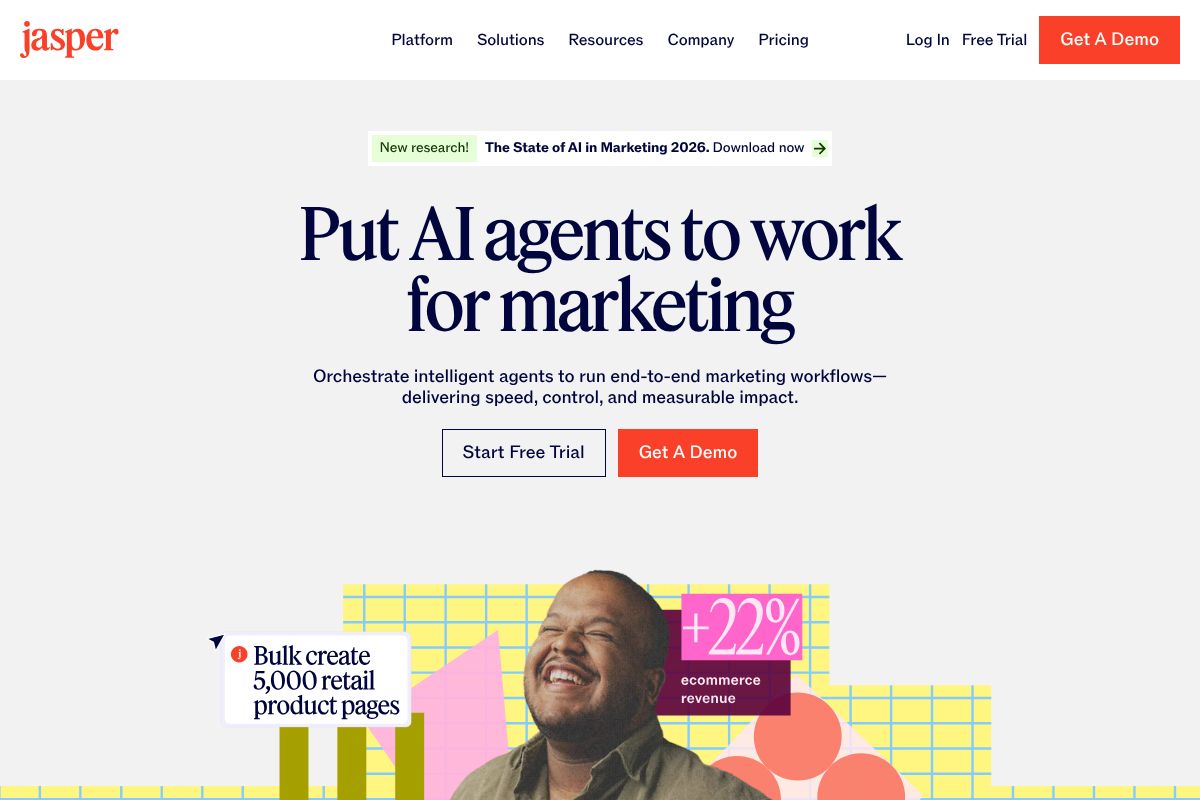
You can feed Jasper your brand guidelines, tone preferences, and sample content, and it will mirror that style across everything it generates. In 2026, Jasper expanded its team collaboration features, making it easier for multiple writers and approvers to work inside the same workspace without stepping on each other.
Best use case: Agencies and in-house marketing teams managing multi-channel campaigns at scale.
- Brand voice training for consistent output across campaigns
- Team collaboration tools with role-based access
- High-volume content workflows with reusable templates
- Pricing: Creator ($49/mo), Pro ($69/mo), Teams ($125/mo)
The Teams tier is where Jasper really shines for agencies — it’s not cheap, but the consistency and collaboration features justify the cost if you’re running content at scale.
Copy.ai: Best for Solo Creators & Small Businesses
Copy.ai lowers the barrier to entry better than almost any other tool in this space. Its free tier is genuinely usable — not a stripped-down teaser — making it an ideal starting point if you’re bootstrapping and want to test AI-assisted writing before committing to a paid plan.
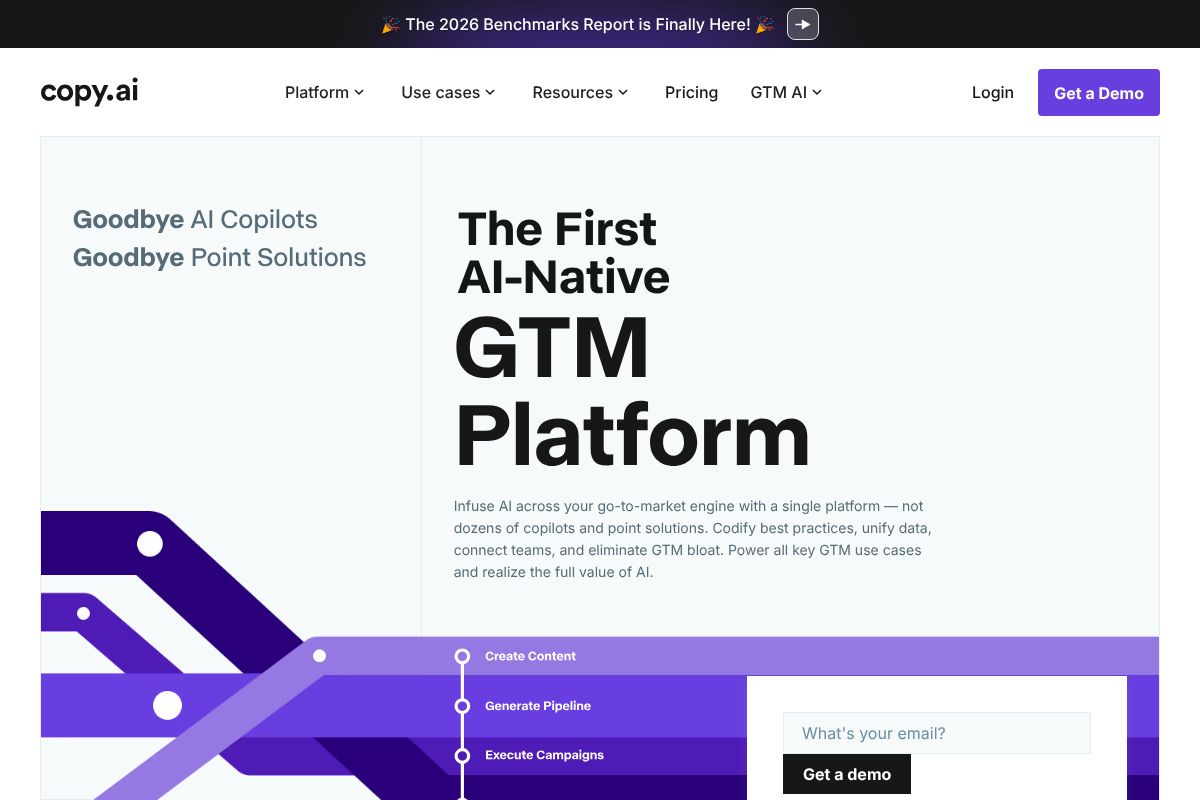
In 2026, Copy.ai significantly improved its free plan and rolled out a more capable AI Agents feature, which lets you automate multi-step content workflows without writing a single line of code. For solo creators who want to punch above their weight, this is a meaningful upgrade.
Best use case: Freelancers, solopreneurs, and small business owners who need versatile content without a big budget.
- Free tier with no credit card required
- AI Agents for automated, multi-step content workflows
- Simple, beginner-friendly interface
- Pricing: Free, Chat ($29/mo), Pro ($49/mo), Agents ($249/mo)
Writesonic: Best for SEO-Focused Bloggers
If growing organic search traffic is your primary goal, Writesonic is built with you in mind. It goes beyond just generating content — it integrates SEO tools directly into the writing workflow, helping you optimize for search visibility without toggling between five different apps.

Writesonic’s 2026 updates strengthened its content optimization features, including real-time suggestions for keyword placement, readability scoring, and competitive content analysis. For bloggers who want their content to rank, not just read well, that built-in SEO layer is a significant advantage.
Best use case: Bloggers and content marketers who want to combine quality writing with search performance.
- Built-in SEO tools for keyword and content optimization
- Search visibility features integrated into the drafting process
- Long-form article generation with structural guidance
- Pricing: Standard at $39/mo (annual) or $49/mo (monthly)
Writesonic’s pricing is also one of the more approachable in this tier, making it a strong value pick for independent bloggers who don’t have an enterprise budget but still want serious SEO capabilities.
Pricing & Value Breakdown
Understanding what you’re actually paying for — and what you’re getting back — is just as important as the feature list. Here’s a straightforward look at how these tools stack up on price, so you can make a smart decision based on your budget and workload.
| Tool | Free Tier | Starter Price | Best Plan for Most Users | Affiliate Commission |
|---|---|---|---|---|
| Jasper AI | No | $39/mo | Creator ($39/mo) | 30% recurring |
| Copy.ai | Yes | $29/mo (Chat) | Chat ($29/mo) | 30% recurring |
| Rytr | Yes | $9/mo | Unlimited ($29/mo) | 30% recurring |
| Writesonic | No | $39/mo (annual) | Standard ($39/mo) | 30% recurring |
When you factor in the time saved — even just two or three hours a week — most of these tools pay for themselves within the first month. A freelancer billing $75/hour who saves four hours monthly is effectively recovering $300 in productive time for a $29–$49 subscription.
Free vs. Paid: Where to Start
If you’re not ready to commit financially, Copy.ai and Rytr are the obvious starting points. Both offer genuine free tiers — not just trials — so you can explore the interface, test output quality, and figure out whether AI writing actually fits your workflow before spending a dollar.
Upgrading to a paid plan makes sense when you hit one of these thresholds:
- You’re producing more than 5–10 pieces of content per month
- You need brand voice controls or team collaboration features
- You want access to long-form generation or SEO integrations
- Free-tier word or usage limits are slowing you down
One thing worth noting: all four tools on this list offer a 30% recurring affiliate commission. If you’re a blogger or creator who recommends tools to your audience, that’s meaningful passive income — not a one-time payout, but ongoing revenue as long as your referrals stay subscribed.
For most solo creators and small business owners, the sweet spot is a mid-tier plan in the $29–$49/month range. That’s where you get the features that actually move the needle without paying for enterprise capacity you’ll never use.
Pros, Cons & Trade-Offs
No AI content generator is a perfect fit for every person or every project. Before you commit to any tool, it’s worth being clear-eyed about what these platforms do well — and where they consistently fall short. The goal here isn’t to talk you out of using AI; it’s to help you use it with realistic expectations.
Here are the trade-offs that come up most often across all four tools:
- Speed vs. customization: AI can produce a draft in seconds, but getting output that truly matches your brand voice often requires multiple rounds of prompting and editing — especially early on.
- Cost vs. features: Free tiers are genuinely useful for low-volume needs, but the features that make AI writing powerful — brand memory, long-form generation, SEO integration — are almost always locked behind paid plans.
- Hallucinations: Every AI writing tool occasionally generates plausible-sounding information that’s simply wrong. Statistics, dates, product details, and citations all require human fact-checking before publication.
- Learning curve: Getting consistently good output means learning how to prompt well. That’s a real skill, and it takes time to develop.
- Human editing is non-negotiable: AI-generated drafts rarely go straight to publish. Plan to spend time refining tone, fixing awkward phrasing, and adding the specific details that make content feel authentic.
When AI Content Generators Fall Short
There are specific scenarios where AI alone genuinely isn’t enough — and it’s important to know them upfront. Highly technical content, such as medical, legal, or engineering writing, requires subject-matter expertise that no current AI tool reliably provides. Original research and data journalism still need a human to gather, interpret, and contextualize real-world findings.
Perhaps most importantly, brand storytelling — the kind that builds genuine emotional connection with an audience — depends on human experience, perspective, and voice. AI can mimic a tone, but it can’t replicate the authenticity that comes from lived experience.
Think of these tools as a capable first-draft assistant, not a replacement for your creative judgment. The best results come when you treat AI output as raw material — something to shape, challenge, and elevate — rather than finished work.
Who Should Use Each Tool?
Not every AI content generator is built for the same workflow — and choosing the wrong one can mean paying for features you’ll never use or hitting frustrating limitations right when you need speed. Here’s a straightforward framework to help you match the right tool to your actual situation.
For Freelancers & Solo Creators
If you’re working independently, your two biggest pain points are probably budget and turnaround time. You need something that gets you from blank page to solid draft fast, without locking you into an expensive monthly commitment.
This is where Copy.ai and Rytr shine. Copy.ai’s free tier gives you a genuine taste of the platform before you spend a cent — useful when you’re juggling multiple client projects and cash flow is unpredictable. Rytr’s budget-friendly pricing makes it one of the most accessible options if you need consistent output without the overhead. Both tools are intuitive enough that you won’t spend hours learning a new system just to write a product description or social caption.
- Low or no upfront cost to get started
- Simple interfaces designed for quick, standalone tasks
- Flexible enough to switch between content types across different clients
For Marketing Teams & Agencies
When you’re working across a team, the challenge shifts. It’s less about getting something written and more about getting the right thing written consistently — on brand, at volume, with multiple people contributing.
Jasper AI is the premium choice here. Its brand voice features help you lock in tone and style guidelines so every piece of content — whether written by you or a colleague — sounds like it came from the same place. For high-output campaigns, product launches, or agencies managing multiple client accounts, Jasper’s collaboration tools and workflow integrations justify the higher price point.
- Team workspaces and role-based access
- Brand voice controls to maintain consistency at scale
- Built for high-volume production without quality drop-off
Final Verdict: Which Should You Choose?
Here’s the honest truth: there’s no single best AI content generator in 2026. The right tool depends on your budget, your workflow, and what you’re actually trying to produce. A solo freelancer writing social captions has very different needs from a marketing team running multi-channel campaigns — and the pricing reflects that gap.
By 2026, the gap between content generators has stopped being about quality and started being about fit—which features, integrations, and workflows actually mesh with how you operate. We’ve mapped out the strongest options so you can spot your ideal tool instantly.
If you’re just getting started, don’t overthink it. Begin with a free tier to get a feel for AI-assisted writing without any financial commitment. Copy.ai and Rytr are the easiest entry points — low friction, no credit card required for basic access. If you find yourself hitting limits or needing more consistency across a team, that’s your signal to look at upgrading to a paid plan or exploring Jasper AI‘s more robust feature set.
The worst move is spending weeks comparing tools without actually trying them. Most platforms offer free trials or money-back guarantees, so the risk of testing is minimal.
Next Steps: Getting Started Today
The fastest way to find your fit is to test two or three tools side by side on a real project — not a demo, but something you actually need to write this week. You’ll know within an hour or two which interface clicks for you.
Try Copy.ai free to explore its template library and workflow builder, or start a 7-day trial with Jasper AI to see how brand voice controls and team features hold up under real conditions. Most tools — including Jasper AI — also offer money-back guarantees on paid plans, so you’re not locked in if it doesn’t work out.
- Start with a free plan on Copy.ai or Rytr if budget is a priority
- Upgrade to Jasper AI if you need team collaboration or SEO-focused output at scale
- Test with a real content task — not a sample prompt — to get an accurate read
Pick one, try it today, and give yourself a week before deciding. That’s all it takes to know whether AI content tools are worth it for your workflow — and at this point, for most creators and marketers, they absolutely are.
Our Verdict
Editorial rating: 4.6/5
Powerful tools with meaningful trade-offs remain.
AI content generators have matured significantly by 2026, offering genuine productivity gains for teams and solopreneurs. The best choice depends on balancing speed against creative control—faster tools sacrifice nuance, while premium options provide better customization but require higher investment and learning curves.
Frequently Asked Questions
What is the fastest AI content generator for bulk writing?
Speed leaders like Copy.ai and Jasper generate 1000+ words in minutes, ideal for scaling content production. However, faster generation sometimes sacrifices nuance, requiring human editing for brand-specific tone and factual accuracy.
Can AI content generators replace human writers completely?
AI generators excel at drafts, outlines, and routine content but lack human creativity, fact-checking, and strategic thinking. Most professionals use them as writing assistants rather than replacements, reducing production time by 40-60% while maintaining quality.
Which AI content generator is best for SEO optimization?
Surfer AI and Jasper lead in SEO integration, offering keyword research, competitor analysis, and SERP-optimized suggestions. They analyze top-ranking content and generate copy aligned with search intent, improving organic visibility significantly.
Do AI content generators produce plagiarism-free content?
Reputable generators like ChatGPT, Claude, and Jasper produce original content trained on diverse sources. However, plagiarism checkers occasionally flag similar phrasing to existing content, so verification remains essential for publishing.
Related Reads
- Best AI Tool for Blog Posts: Top Picks for 2024
Find the best AI tool for blog posts. Compare Jasper, Copy.ai, Writesonic & Rytr. Honest reviews, pricing, and which fit…
- Jasper AI Review 2026: Is It Worth the Cost?
Honest Jasper AI review for 2026. See pricing, features, pros/cons, and how it compares to Copy.ai and Writesonic for co…
- Best AI Writing Assistant for Freelancers in 2026
Find the best AI writing assistant for freelancers. Compare top tools, pricing, and features to boost your productivity …