You’ve heard that SEO can transform your website’s traffic — but every time you try to get started, you’re buried under keyword research, competitor analysis, content optimization, and a dozen other tasks that feel like they require a marketing degree. Sound familiar? Finding the best AI tool for SEO beginners in 2026 isn’t just about picking the most popular option — it’s about finding something that actually makes sense when you’re starting from zero.
AI has genuinely democratized SEO strategy, making professional-level tools accessible to anyone without an agency budget or technical background. We’ve tested the top options and identified which one will actually move the needle for beginners without the overwhelm.
Key Takeaways
- AI SEO tools automate keyword research, content optimization, and competitor analysis, saving beginners hours of manual work monthly.
- Beginner-friendly AI tools prioritize intuitive interfaces, clear explanations, and affordable pricing over advanced features most newcomers won’t use.
- Top AI SEO platforms offer free trials or freemium plans, allowing beginners to test functionality before committing financially.
- Combining multiple AI tools strategically—one for keyword research, another for content—often delivers better results than relying on single platforms.
- Starting with simple, focused AI tools prevents overwhelm; beginners should master basics before upgrading to enterprise-level SEO solutions.
In This Article
- Why AI SEO Tools Matter for Beginners
- What Makes an AI SEO Tool Beginner-Friendly
- Top AI SEO Tools for Beginners: Feature Breakdown
- Pros and Cons: Which Tool Fits Your Needs
- Pricing and Value for Beginners
- Who Should Use Each Tool
- Getting Started: Your First Steps
- Final Verdict: Start Simple, Scale Smart
Why AI SEO Tools Matter for Beginners
Let’s be honest — traditional SEO is genuinely hard to learn. Between decoding Google’s ever-changing algorithm, figuring out which keywords are worth targeting, and understanding why a competitor outranks you, it can feel like you need years of experience just to get started. For most content creators, marketers, and small business owners, that learning curve is enough to make SEO feel completely out of reach.
The result? You either publish content and hope for the best, or you spend hours on research that doesn’t move the needle. Neither option is sustainable — and neither is paying an SEO agency thousands of dollars a month when you’re just trying to grow your audience or generate a few more leads.
This is exactly where AI SEO tools change the equation. Instead of requiring you to understand every ranking factor, they do the heavy lifting in the background. Think of them as a knowledgeable assistant who can:
- Find the right keywords — without you needing to know what search volume or keyword difficulty actually means
- Analyze your content — and tell you specifically what to improve before you hit publish
- Reverse-engineer competitors — so you understand what’s working in your niche, not just in theory
- Save you serious time — cutting hours of manual research down to minutes
The biggest shift AI brings to SEO isn’t just speed — it’s clarity. Instead of drowning in data, you get actionable recommendations you can actually follow. That means less guesswork, faster results, and a much shorter path from “I have a website” to “people are actually finding it.”
The key, though, is choosing a tool that’s genuinely built with beginners in mind — not one that assumes you already know what you’re doing.
What Makes an AI SEO Tool Beginner-Friendly
Not every AI SEO tool is created equal — and many of the most powerful ones are also the most overwhelming. For beginners, the wrong tool can feel like being handed a cockpit manual when all you need is directions to the nearest coffee shop. So before diving into specific recommendations, it’s worth defining what “beginner-friendly” actually means.
Here are the criteria that matter most when you’re just starting out:
- Intuitive interface — You shouldn’t need a tutorial just to find the main features. A clean, well-organized dashboard saves time and reduces frustration.
- Clear, in-context guidance — The best tools explain what to do and why it matters, rather than just surfacing raw data and leaving you to figure it out.
- Minimal learning curve — You should be able to run your first keyword search or content audit within minutes of signing up, not after a week of onboarding.
- Affordable pricing — Beginner-friendly tools offer meaningful free tiers or low-cost plans that don’t lock core features behind expensive upgrades.
- Actionable insights, not data overload — There’s a big difference between showing you 50 metrics and telling you the three things you should fix first.
That last point deserves a little more attention. A lot of SEO platforms are built for analysts who already understand the context behind the numbers. If a tool shows you a “Domain Authority score” without explaining what it means for your specific situation, it’s not actually helping you move forward.
The tools worth your time as a beginner are the ones that bridge the gap between data and decision. They don’t just tell you what your content is missing — they tell you why it matters and give you a clear next step. That combination of simplicity, context, and affordability is the benchmark everything else in this article is measured against.
Top AI SEO Tools for Beginners: Feature Breakdown
With so many SEO tools on the market, narrowing down the right starting point can feel overwhelming. The three tools below each serve a distinct purpose — and they’re not all created equal in terms of complexity or cost. Here’s an honest look at what each one does well, where it falls short, and who it’s really built for.
Surfer SEO SEO: Best for Content Writers
Surfer SEO is designed to help you optimize content as you write it, rather than after the fact. Its content editor gives you a real-time score based on how well your draft aligns with top-ranking pages, so you’re not guessing — you’re adjusting on the fly.

- Real-time optimization feedback built directly into the writing interface
- Competitor analysis surfaced inside your document, not in a separate dashboard
- Keyword suggestions and content structure guidance tailored to your target topic
- Integrates with Google Docs and WordPress for a seamless workflow
For bloggers and content marketers who want to improve rankings without leaving their writing environment, Surfer SEO is one of the most intuitive options available. Plans run from $89 to $219 per month, which is a meaningful investment — but the guided workflow makes it genuinely accessible for beginners.
NeuralText: Best for Building Content Clusters
NeuralText takes a slightly different approach, focusing on topical authority — helping you map out clusters of related content that signal expertise to search engines. If you’re trying to grow an audience around a specific niche, this matters a lot.
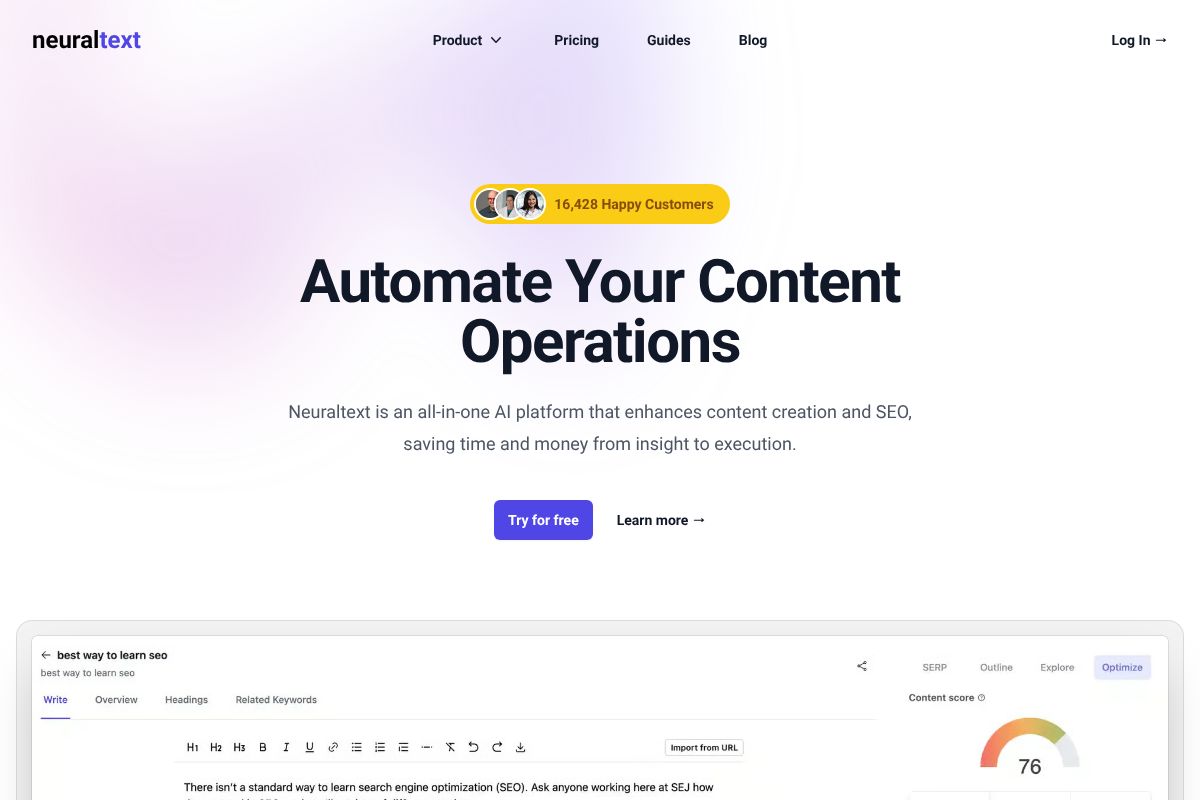
- AI-powered content briefs that outline what to cover and why
- Topical authority mapping to identify content gaps in your strategy
- Keyword clustering tools that group related terms intelligently
- Clean, beginner-friendly interface with a low barrier to entry
At $19 to $119 per month, NeuralText is the most budget-friendly option in this lineup — making it a smart starting point if you’re scaling content on a tight budget. The trade-off is that it’s more narrowly focused than a full-suite platform, so you may eventually need additional tools as your strategy matures.
Semrush: Best for Comprehensive SEO (Steeper Learning Curve)
Semrush is arguably the most powerful SEO platform available — but that power comes with complexity. It covers everything from keyword research and rank tracking to competitor analysis, backlink auditing, and site health monitoring. The depth of data is impressive; the onboarding experience, less so.
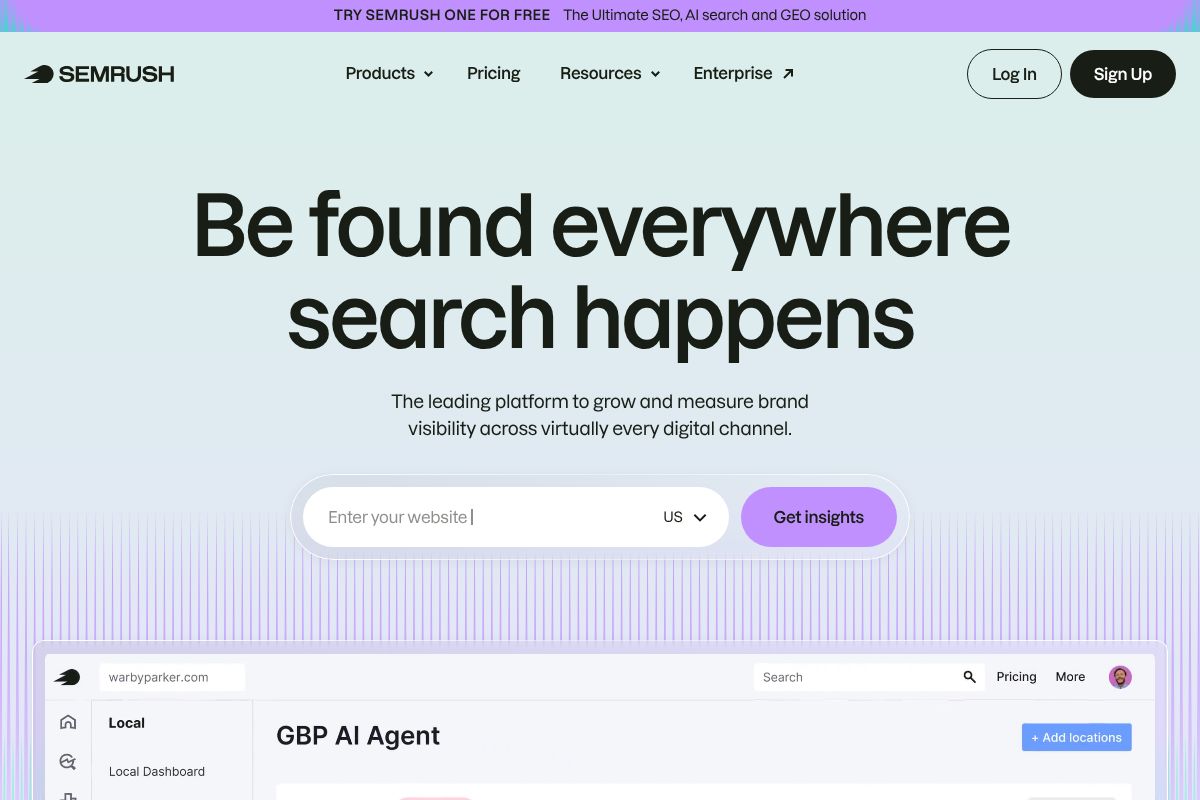
- Comprehensive keyword research with intent filtering and difficulty scoring
- Rank tracking across multiple search engines and locations
- Competitor analysis tools that reveal what’s working in your space
- Content marketing toolkit, PPC tools, and social media features included
Plans start at $139.95 and go up to $499.95 per month, which puts it firmly in the professional tier. For most beginners, the interface can feel like stepping into a cockpit without a flight manual. That said, Semrush is worth knowing about — think of it as a tool to grow into once you’ve built a foundation with something simpler. If you’re already comfortable with basic SEO concepts and want one platform to do everything, it’s hard to beat.
Pros and Cons: Which Tool Fits Your Needs
Every tool in this list has real strengths — and real limitations. The right choice depends on where you are in your SEO journey, how much you want to spend, and what kind of work you’re actually doing day to day. Here’s an honest breakdown.
Surfer SEO
- Pro: Exceptional content editor that makes on-page optimization intuitive and actionable
- Pro: Clean, beginner-friendly interface — you can produce optimized content quickly without a steep learning curve
- Pro: Real-time scoring helps you understand why changes matter, not just what to change
- Con: Keyword research capabilities are limited compared to dedicated research tools
- Con: Not a full SEO suite — you’ll likely need a separate tool for rank tracking and backlink analysis
Best for: Writers, bloggers, and content marketers who already have keywords in mind and want help turning them into well-optimized articles.
NeuralText
- Pro: Most affordable option in the group — solid value for freelancers and small teams
- Pro: Combines keyword clustering and content briefs in one place, which saves meaningful time
- Pro: Low barrier to entry — easy to get started without prior SEO experience
- Con: Less comprehensive than either Surfer or Semrush in terms of data depth
- Con: Smaller feature set means you may outgrow it as your SEO strategy becomes more sophisticated
Best for: Budget-conscious beginners who want a no-fuss starting point for content planning and basic keyword research.
Semrush
- Pro: Covers virtually every aspect of SEO in a single platform
- Pro: Unmatched competitor analysis and keyword data — genuinely useful at any level
- Con: Expensive, especially for solo creators or small businesses just getting started
- Con: The interface can overwhelm beginners — there’s a real learning curve before you feel productive
Best for: Those who’ve moved past the basics and want one powerful platform to manage their entire SEO strategy long-term.
Pricing and Value for Beginners
When you’re just starting out with SEO, it’s easy to either overspend on tools you’re not ready to use or underspend on something so limited it doesn’t move the needle. Here’s how each tool stacks up when you weigh the cost against what you actually get back in time and results.
NeuralText — Starting at $19/month
NeuralText offers the lowest entry point of the three, making it the most beginner-friendly from a budget perspective. At $19/month, you get access to keyword clustering and content brief generation — two tasks that would otherwise eat up hours of manual research. If you’re a freelancer or solo creator just building your SEO workflow, this is a reasonable place to start without a significant financial commitment.
- Entry-level plan starts at $19/month
- Annual billing typically reduces the overall cost — worth checking before you commit monthly
- Best approached as a starting tier; scale up only when your content output grows
Surfer SEO — The Mid-Range Sweet Spot Around $89/month
Surfer sits in the middle of the pricing spectrum, and for many beginners who are serious about content, it hits a genuine sweet spot. At around $89/month, you’re getting real-time content optimization that directly improves your writing as you go — which translates to fewer rewrites and faster rankings. Surfer also offers a free trial, so you can test it before committing.
- Plans start around $89/month at the entry tier
- Annual plans offer meaningful savings compared to month-to-month billing
- Think of it as paying for a part-time SEO editor — the time saved per article adds up quickly
Semrush — Premium Positioning
Semrush is the most expensive option here, and that cost is harder to justify when you’re still learning the fundamentals. That said, it does offer a limited free tier and occasional trial periods that let you explore the platform before spending anything. If you do invest, treat it as a long-term tool rather than a quick fix.
- Paid plans start significantly higher than both NeuralText and Surfer
- A free account with limited features is available — a smart way to get familiar before upgrading
- Best value when you’re publishing consistently and need competitive intelligence, not just content help
The bottom line: Start with the lowest tier that covers your immediate needs, and treat the monthly cost as an investment in time saved rather than just another subscription. Even saving three or four hours of research per month at a freelancer’s hourly rate makes most of these tools pay for themselves.
Who Should Use Each Tool
Not every SEO tool is built for the same person, and picking the wrong one can leave you overwhelmed — or underpowered. Here’s a quick breakdown of who gets the most value from each option.
Choose Surfer SEO If You’re a Content Writer
If your primary goal is writing and optimizing articles, Surfer SEO fits naturally into your workflow. It gives you real-time feedback as you write, which means you’re improving your content while you create it — not after the fact. This makes it ideal for freelance writers, bloggers, and content marketers who publish regularly and want every piece to perform as well as possible from day one.
- You write and publish articles frequently
- You want on-page guidance without needing to learn deep SEO theory
- You work alone or in a small content team
Choose NeuralText If You’re Building a Content Library on a Budget
NeuralText is a strong fit if you’re trying to establish topical authority across a subject area without spending heavily upfront. It’s especially useful for small business owners and solo creators who want to plan out clusters of content and cover a topic thoroughly. If budget is a real constraint, this is where to start.
- You’re mapping out content strategy, not just individual articles
- You want AI writing assistance alongside SEO research in one tool
- You’re cost-conscious but still serious about growing organic traffic
Choose Semrush If You Need the Full Picture
Semrush makes the most sense for marketers and small business owners who need to understand their competitive landscape — not just optimize individual pages. If you want to track rankings, spy on competitors, and audit your entire site, Semrush gives you that visibility in one place.
- You’re managing SEO for a business, not just a personal blog
- You need keyword tracking, backlink data, and competitor analysis
- You’re ready to move beyond beginner-level strategy
When It Makes Sense to Combine Tools
Some users find that pairing tools gives them an edge. A common setup is using Semrush for research and competitive intelligence, then bringing that data into Surfer SEO to optimize the actual content. It’s a more expensive approach, but if SEO is central to your business, the overlap is often worth it.
Getting Started: Your First Steps
The biggest mistake beginners make is trying to learn every tool at once. You don’t need all three platforms on day one — and honestly, spreading your attention that thin will slow you down more than it helps. A focused approach will get you to results faster.
Here’s a simple roadmap to follow:
- Start with a free trial. All three tools offer some form of free access or trial period. Use it to test the interface before spending a cent. If the tool feels confusing or unintuitive within the first hour, that’s useful information.
- Pick one tool based on your primary need. If you need help with the actual writing, start there. If content planning and keyword research are your gap, focus on that first. If you want competitive data and site auditing, go straight to a research-focused platform.
- Spend one to two weeks on the basics. Most tools offer onboarding tutorials, help centers, and video walkthroughs. Use them. You’ll get more out of the tool in week three than someone who skipped that foundation.
- Scale once you’ve built confidence. After you’ve seen real results from your first tool, adding a second one makes much more sense — both financially and practically.
The goal isn’t to master SEO software. It’s to publish better content more consistently. Keep that in mind as you get started, and don’t let tool overload become the reason you don’t begin at all.
Final Verdict: Start Simple, Scale Smart
There’s no single “best” AI SEO tool for beginners — but there is a best one for you, depending on your role, your goals, and what you can realistically spend right now.
Here’s how to think about it:
- If you’re a writer or content creator, Surfer SEO offers the smoothest on-ramp. Its Content Editor is intuitive, and you’ll see the value almost immediately.
- If you’re budget-conscious, NeuralText delivers solid keyword research and content briefs without a steep monthly commitment — a smart starting point when you’re still testing the waters.
- If you’re a marketer ready to invest in long-term growth, Semrush is the platform you’ll grow into rather than out of. It’s more complex upfront, but the depth pays off over time.
Ultimately, the best tool is the one you’ll actually open and use consistently. A powerful platform you ignore will always lose to a simpler one you use every week.
Don’t overthink it. Pick the option that fits your workflow, start with a free trial, and build from there. Try a free trial today — whether it’s Surfer SEO, NeuralText, or Semrush — and take your first real step toward smarter, more effective content.
Frequently Asked Questions
What is the easiest AI tool for SEO beginners to use?
Tools with drag-and-drop interfaces and pre-built templates like Semrush or Ahrefs are easiest for beginners. They offer guided workflows that eliminate technical complexity while delivering actionable SEO insights without coding knowledge.
Can I use free AI SEO tools as a beginner?
Yes, many platforms offer free or freemium versions suitable for beginners. Google Search Console, Ubersuggest’s free tier, and ChatGPT provide keyword research, rank tracking, and content optimization capabilities without upfront investment.
How much should beginners spend on AI SEO tools monthly?
Beginners typically spend $0-50 monthly starting with free tools, then $50-100 for mid-tier subscriptions as they scale. Premium plans ($200+) become worthwhile only after mastering fundamentals and seeing measurable ROI.
Which AI SEO tool is best for content optimization?
Surfer SEO and Clearscope excel at content optimization by analyzing top-ranking pages and providing real-time recommendations. Both tools help beginners match search intent and improve rankings without requiring advanced SEO knowledge.
Related Reads
- Surfer SEO vs NeuralText: Which AI Tool Wins in 2026?
Compare Surfer SEO and NeuralText in 2026. See pricing, features, and which AI SEO tool fits your content strategy best.…
- Surfer SEO vs Frase: Which AI Tool Wins in 2026?
Compare Surfer SEO and Frase in 2026. See pricing, features, and which AI SEO tool fits your content strategy best.…
- Best Keyword Research Tool for 2026: Top Picks
Find the best keyword research tool for your needs in 2026. Compare top SEO tools with honest reviews, pricing, and reco…