Editor’s note: Reviewed and updated in June 2026 to reflect current pricing, features, and 2026 tool releases.
You’ve got a blog post due, a product description to polish, and three social captions that still say “write something catchy here.” Sound familiar? AI writing tools promised to fix exactly this kind of chaos — but now you’re stuck choosing between two of the most popular options on the market. In the Copy.ai vs Writesonic debate, both tools have matured significantly, and picking the wrong one could mean paying for features you’ll never use. This article breaks down how each platform performs in 2026 across pricing, writing quality, templates, and everyday usability — so you can make a confident decision without having to test both yourself.

Key Takeaways
- Copy.ai excels at bulk content generation with affordable pricing, while Writesonic offers superior AI quality and advanced customization features for professional users.
- Writesonic’s real-time web search integration provides fresher, more accurate content than Copy.ai’s template-based approach for current-event writing.
- Copy.ai wins on affordability with free tier access, but Writesonic justifies premium pricing through better SEO optimization and brand voice consistency.
- Both tools support multiple content formats, yet Writesonic’s AI models demonstrate stronger grammatical accuracy and contextual understanding in 2026.
- Choose Copy.ai for quick, budget-friendly content scaling; select Writesonic for quality-focused projects requiring advanced editing and fact-checking capabilities.
In This Article
- Introduction: The AI Writing Tool Showdown
- Copy.ai-and-writesonic”>What Are Copy.ai and Writesonic?
- Key Features: Side-by-Side Breakdown
- Pricing Comparison: What You’ll Actually Pay
- Pros and Cons: The Honest Trade-Offs
- Feature Comparison Table
- Who Should Use Each Tool?
- The Verdict: Which Should You Pick?
Introduction: The AI Writing Tool Showdown
If you’ve spent any time researching AI writing tools, you’ve almost certainly come across both Copy.ai and Writesonic. They’re two of the most recognized names in the space, and for good reason — both have been refining their platforms for years and have built up loyal user bases across content creators, marketers, and small business owners.
But popular doesn’t always mean right for you. Copy.ai and Writesonic have taken noticeably different directions in 2026, and what works brilliantly for a solo freelancer might feel clunky and over-engineered for a marketing team — or vice versa. Choosing the wrong tool doesn’t just cost you money; it costs you time you don’t have.
So how do you actually decide? This comparison cuts through the noise by looking at the factors that matter most in day-to-day use:
- Pricing and value — What do you actually get at each tier?
- Writing quality and output — Does the copy sound human, or does it need heavy editing?
- Templates and use cases — Which tool covers your specific workflow?
- Ease of use — Can you get results quickly, or is there a steep learning curve?
Neither tool is objectively “better” — they’re built with different users in mind. By the end of this breakdown, you’ll have a clear picture of which one fits your work style, your budget, and the kind of content you create most often.
What Are Copy.ai and Writesonic?
Before diving into a head-to-head comparison, it helps to understand what each tool was actually built to do. Both Copy.ai and Writesonic generate AI-powered written content, but they’ve evolved with different users and different problems in mind. Knowing their origins makes it a lot easier to figure out which one is solving your problem.
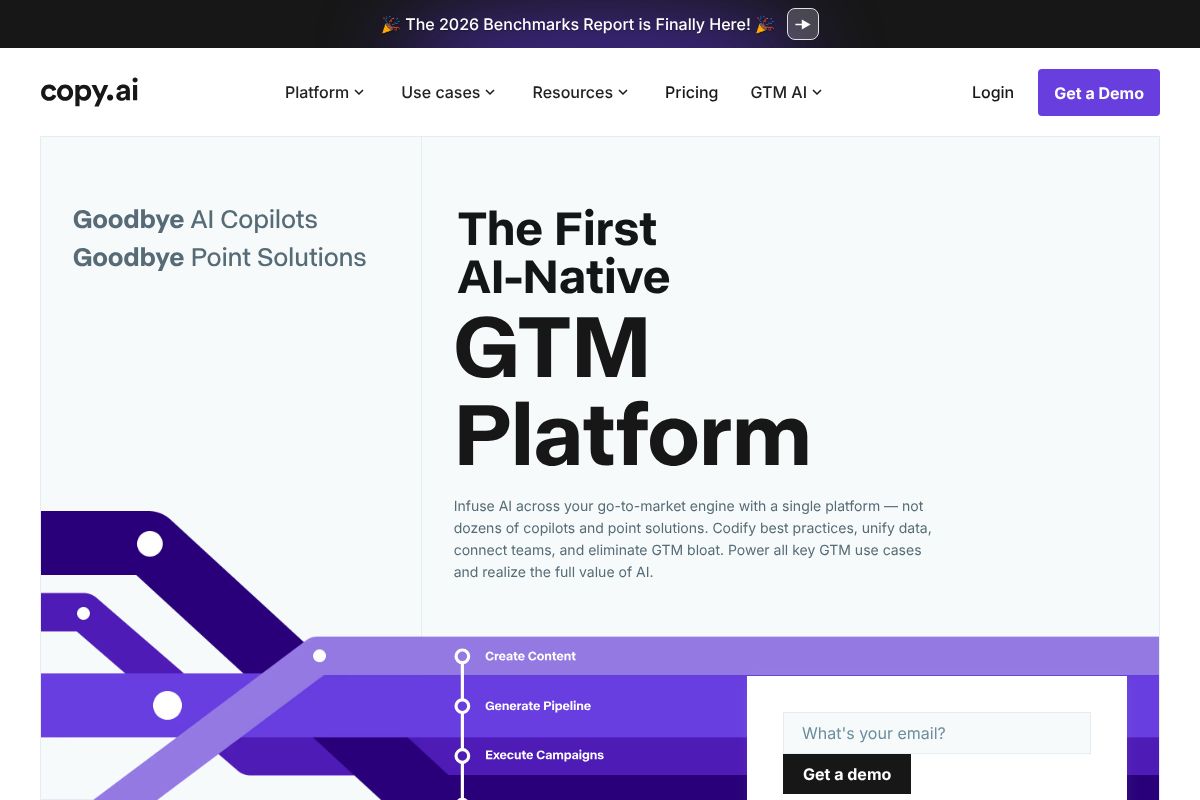
Copy.ai’s Approach
Copy.ai launched as one of the first accessible AI writing tools — the kind you could jump into without a tutorial, generate a product description or social media caption, and walk away feeling like you’d saved an hour. That simplicity was its superpower early on, and it’s still a big part of its appeal today.
What’s changed is the scope. Copy.ai has grown well beyond a basic copy generator into a multi-tool platform that includes chat-based writing, workflow automation, and AI agent features designed to handle more complex, multi-step tasks. Crucially, it still offers a free tier, which makes it one of the most accessible entry points for solo creators and freelancers who want to experiment with AI writing without committing to a subscription right away.
If you’re a one-person operation looking for a flexible tool that grows with you, Copy.ai is built with that journey in mind.
Writesonic’s Positioning
Writesonic has always had a sharper focus: helping you create content that doesn’t just read well, but actually gets found. From early on, the platform leaned into SEO as a core feature rather than an afterthought, making it a natural fit for bloggers, content marketers, and anyone whose success depends on organic search traffic.
In 2026, that positioning has only become more defined. Writesonic integrates content creation with search visibility tools, so you’re not just writing — you’re writing with a strategy. It’s built for users who think in terms of keywords, rankings, and content calendars rather than one-off copy needs.
If your day-to-day involves producing SEO-driven articles, landing pages, or blog content at scale, Writesonic is designed specifically around that workflow.
Key Features: Side-by-Side Breakdown
Both tools cover the core bases you’d expect from an AI writing platform, but they make very different choices about where to go deep. Understanding those differences will save you from paying for features you’ll never use — or worse, missing the ones you actually need.
Copy.ai’s Feature Set
Copy.ai leads with breadth. The platform offers a large library of content templates covering everything from social media captions and email subject lines to product descriptions and sales copy. If you’re regularly switching between different content types, that variety is genuinely useful.
The chat interface feels intuitive even if you’re new to AI tools — you can prompt it conversationally without learning any special syntax. Beyond chat, Copy.ai’s Workflows and AI Agents let you string together multi-step tasks, like researching a topic, drafting an outline, and writing a first draft in a single automated run. That’s a meaningful time-saver for repetitive content processes.
Brand voice customization is solid here too. You can define your tone and style preferences so outputs feel consistent across projects. Integrations include popular tools like HubSpot, Salesforce, and Zapier, which makes it easier to fit Copy.ai into an existing marketing stack. Collaboration features are available on higher-tier plans, though they’re fairly basic compared to dedicated project management tools.
Where Copy.ai is lighter: built-in SEO guidance is minimal, and long-form article creation isn’t its strongest suit.
Writesonic’s Strengths
Writesonic is built around content that performs. Its AI Article Writer is one of the more capable long-form tools available at this price point — it can produce structured, research-informed drafts that are ready to edit rather than rewrite entirely.
The platform’s SEO integration sets it apart. You get keyword suggestions, content scoring, and optimization guidance baked directly into the writing workflow, not bolted on as an afterthought. That means you’re thinking about search intent as you write, not after.
Botsonic, Writesonic’s chatbot builder, is a standout feature for small business owners who want to add a branded AI assistant to their website without hiring a developer. Integrations with Surfer SEO, WordPress, and Google Search Console make it particularly strong for content-focused teams.
Collaboration tools are more developed here than on Copy.ai, which matters if you’re working with a small editorial team. The main gap is template variety — Writesonic is narrower in scope, so if you need quick short-form copy across many formats, it feels less flexible.
If neither tool quite fits your needs and you’re working at an enterprise level, Jasper AI AI is worth a look — it offers more advanced brand voice controls, deeper team collaboration, and a more polished long-form editor, though at a noticeably higher price point.

Pricing Comparison: What You’ll Actually Pay
Price is often the deciding factor when two tools are closely matched on features. Both Copy.ai and Writesonic offer free entry points, which means you can test before you commit — a genuine advantage over some competitors that hide everything behind a paywall. Here’s how the tiers break down in 2026.
Copy.ai Pricing Tiers
Copy.ai’s pricing structure is one of its more appealing qualities, especially if you’re just getting started. The Free plan gives you access to core writing tools with no credit card required — a solid way to evaluate whether the platform fits your workflow before spending anything.
- Free: Limited but functional — good for occasional use and testing the interface
- Chat ($29/month): Unlocks more outputs and is well-suited to casual creators or solopreneurs who write a few times a week
- Pro ($49/month): The sweet spot for regular content creators — removes most usage limits and adds workflow features
- Agents ($249/month): Built for teams that want to automate multi-step content workflows at scale — significant investment, but a different category of tool entirely
Most freelancers and small business owners will find the Pro plan covers everything they need. The Agents tier is genuinely powerful, but it’s priced for teams with real automation needs, not individual creators.
Writesonic Pricing Tiers
Writesonic also offers a Free tier that gives you a taste of the platform’s core features, including limited access to the AI Article Writer. It’s enough to get a feel for the output quality before upgrading.
- Free: Limited word credits, but covers basic use cases for evaluation
- Standard ($49/month or $39/month billed annually): Full access to long-form writing, SEO tools, and Botsonic — the annual plan saves you roughly 20% compared to paying month-to-month
The annual discount is worth considering if you’re planning to use Writesonic consistently. At $39/month on the annual plan, you’re getting a capable SEO-focused writing suite at a competitive price. If you prefer flexibility, the monthly option is available at $49 — slightly more expensive, but commitment-free.
On value per dollar, Copy.ai’s Pro plan and Writesonic’s Standard annual plan are closely matched. Your choice really comes down to whether you prioritize template variety and automation potential (Copy.ai) or SEO-integrated long-form content (Writesonic).
Pros and Cons: The Honest Trade-Offs
No AI writing tool is perfect for everyone, and both Copy.ai and Writesonic have real strengths alongside genuine weaknesses. Here’s an honest breakdown so you can make a clear-eyed decision — not one based on marketing copy.
Copy.ai Pros & Cons
Copy.ai’s biggest selling point is accessibility. The free tier is genuinely usable — not a bait-and-switch — and the chat interface makes it approachable even if you’ve never used an AI writing tool before. It’s a strong choice when you need quick copy across a wide variety of formats.
- Free tier that actually works: You can produce real output without entering a credit card
- Variety of templates: Hundreds of use cases covered, from ad copy to email sequences
- Intuitive chat interface: Feels natural to use, even for beginners
- Automation potential: The Workflows feature adds serious power for teams willing to explore it
That said, the sheer number of features can work against you. If you sit down to write a blog post and find yourself clicking through a dozen different tools, that’s a real productivity drain. Copy.ai also isn’t built with SEO as a core focus — you won’t find keyword optimization or SERP analysis baked in. Output quality can also vary depending on which template or workflow you use, which means more editing time on your end.
- Feature overload: Too many options can create decision fatigue
- Limited SEO tooling: No native keyword research or optimization features
- Inconsistent output quality: Results vary across templates and use cases
Writesonic Pros & Cons
Writesonic is built with a clearer purpose: help you create long-form, search-optimized content efficiently. That focus shows in the quality of the output and the depth of the SEO tools available. If ranking on Google is part of your strategy, that integration is genuinely valuable.
- SEO integration: Built-in keyword tools and optimization features set it apart
- Long-form content quality: Article Writer produces more structured, publish-ready drafts
- Focused feature set: Less clutter means a more streamlined workflow
- Annual savings: The 20% discount on annual billing makes it cost-competitive
The trade-offs are real, though. There’s no true free tier — the free plan is limited enough that it’s really just a trial. Writesonic also offers fewer templates than Copy.ai, which matters if you need quick short-form copy across many formats. And the platform has a steeper onboarding curve; it rewards users who invest time learning it, but that’s not always time you have.
- No meaningful free tier: You’ll need to pay to get full value
- Fewer templates: Less versatile for short-form or varied copy needs
- Steeper learning curve: Takes more time to get comfortable with the full feature set
Feature Comparison Table
If you’re short on time, here’s a side-by-side look at how Copy.ai and Writesonic stack up across the features that matter most. Use this as a quick reference before diving into the deeper analysis below.
| Feature | Copy.ai | Writesonic |
|---|---|---|
| Free Tier | Yes — generous free plan | Trial only — very limited |
| Pricing (Paid) | Starts ~$49/month | Starts ~$20/month |
| Templates | 90+ templates | Fewer, more focused |
| SEO Tools | Basic | Built-in, robust |
| AI Chat | Yes — Chat by Copy.ai | Yes — Chatsonic |
| Long-Form Content | Capable but limited | Strong — core feature |
| Integrations | Zapier, CRM workflows | Surfer SEO, WordPress |
| Best For | Short-form copy, marketers | Blog content, SEO writers |
Neither tool dominates every category — your best choice really comes down to what type of content you create most often and whether SEO optimization is a priority for your workflow.
Who Should Use Each Tool?
Both Copy.ai and Writesonic are solid AI writing tools, but they’re built with different users in mind. Choosing the wrong one won’t ruin your workflow, but choosing the right one will make a noticeable difference in how fast and effectively you create content. Here’s a straightforward breakdown by user type.
Choose Copy.ai If…
You’re a solopreneur or solo creator who wants to dip into AI writing without committing to a paid plan right away. Copy.ai’s free tier is one of the most generous in the space, making it an easy starting point with no credit card pressure.
It’s also a strong fit if your content needs are varied. Copy.ai shines when you’re juggling multiple formats at once — think Instagram captions, email subject lines, product descriptions, and ad copy all in the same week. Its 90+ templates give you a wide playground to work with.
- You manage social media for yourself or a small brand
- You want a free option before spending anything
- You need quick, punchy short-form copy on demand
- You like experimenting with different content formats
- You prefer a simple, low-learning-curve interface
Copy.ai is less ideal if SEO-driven blog content is your primary output — it can handle long-form, but it’s not where the tool truly excels.
Choose Writesonic If…
You’re a blogger or content marketer who publishes regularly and wants your articles to actually rank. Writesonic’s built-in SEO tools and Surfer SEO integration make it a purpose-built choice for writers who care about organic traffic, not just word count.
It’s also the smarter pick if long-form content is your bread and butter. Writesonic’s article generation is a core feature, not an afterthought — and the WordPress integration means you can go from draft to published without leaving your workflow.
- You write SEO blog posts consistently
- You want integrated tools rather than switching between platforms
- You’re a freelance writer or small content agency handling multiple articles per week
- You prefer paying monthly at a lower entry price (~$20/month)
- You want to save more with annual billing
If you’re running a larger team or agency that needs brand voice consistency and high-volume output across multiple clients, it’s also worth looking at Jasper AI — it’s built specifically for collaborative, brand-governed content workflows that go beyond what either of these tools offer at scale.
The Verdict: Which Should You Pick?
There’s no single winner here — and that’s actually good news. Both Copy.ai and Writesonic are genuinely capable tools in 2026, and the right choice comes down to what you’re trying to accomplish on a daily basis.
Think of it this way: your priorities should drive the decision, not the marketing. Ask yourself what you spend most of your content time doing, what your budget looks like, and how much you rely on SEO to grow your audience.
- Tight budget + creative variety? Copy.ai’s free tier and flexible template library give you a lot of room to experiment without spending a cent.
- SEO content + consistent publishing? Writesonic’s article tools, Surfer SEO integration, and WordPress connection make it the more focused, results-driven choice.
- Scaling a team or agency? Consider looking beyond both — Jasper AI is worth exploring as a premium upgrade path built for brand-governed, high-volume content operations.
Final Recommendation
If flexibility and free access matter most, Copy.ai is your starting point. It’s approachable, versatile, and costs nothing to try in a meaningful way. If your focus is on publishing SEO-optimized blog content that actually drives traffic, Writesonic is the more purposeful tool — and at around $20/month, it’s still easy to justify.
The smartest move? Don’t guess — test. Both platforms offer free tiers that let you get hands-on before committing to a paid plan. Spend a week with each, run a few real projects through them, and let your own workflow tell you which one fits.
Start with the free versions today, and you’ll have a clear answer by the end of the week.
Frequently Asked Questions
Is Copy.ai or Writesonic better for SEO content?
Writesonic edges ahead with superior SEO optimization features, keyword integration, and real-time research capabilities. Copy.ai works for basic SEO but lacks advanced ranking optimization tools that Writesonic provides for competitive keyword targeting.
Which AI writer is cheaper, Copy.ai or Writesonic?
Copy.ai offers a free tier and lower-cost plans starting around $49/month, making it cheaper for budget-conscious users. Writesonic’s premium features justify higher pricing at $99+/month for professional-grade content creation and advanced AI models.
Can Copy.ai and Writesonic generate long-form content?
Both tools generate long-form content, but Writesonic produces more coherent, well-structured articles with better flow. Copy.ai requires more manual editing for longer pieces, though it’s faster for generating multiple short-form variations quickly.
Which tool has better customer support, Copy.ai or Writesonic?
Writesonic provides more comprehensive support through live chat, email, and detailed documentation. Copy.ai offers basic email support and community forums, making Writesonic the better choice for users needing responsive, professional customer assistance.
Related Reads
- Jasper vs Writesonic: Which AI Writer Wins in 2026?
Compare Jasper vs Writesonic in 2026. See pricing, features, and which AI writing tool fits your content needs best.…
- Rytr Review 2026: Is This AI Writing Tool Worth It?
Honest Rytr review for 2026. See pricing, features, pros/cons, and how it compares to Jasper, Copy.ai, and Writesonic fo…
- Best AI Tools for Long Form Content in 2026
Find the best AI tools for long form content creation. Compare features, pricing, and performance for creators and marke…