Google’s algorithm updates now ship monthly, sometimes weekly, and half the SEO advice from last year is already stale. So the search for the best AI for SEO in 2026 isn’t about finding a tool that writes 2,000 words in ten seconds — every tool does that now. It’s about finding one that actually understands search intent, competitive gaps, and the technical mess most content plans ignore entirely.
A freelance content strategist we know spent three months feeding a general-purpose AI writer keyword lists, only to watch her client’s traffic flatline while a competitor with half her budget climbed past her. The tool wasn’t broken. It just wasn’t built for ranking — it was built for drafting.
That distinction matters more than any pricing page will tell you.
Key Takeaways
- AI SEO tools automate keyword research, content optimization, and competitive analysis, saving teams hundreds of hours monthly while improving ranking potential.
- Semrush dominates enterprise SEO with comprehensive competitive intelligence, while Surfer SEO excels at real-time content optimization for individual writers and agencies.
- NeuralText delivers professional-grade SEO authority building at fraction of agency costs, ideal for bootstrapped startups and solopreneurs scaling content.
- AI tools accelerate tactical SEO execution but cannot replace strategic thinking, audience research, or building genuine topical authority over time.
- Choosing the right AI SEO tool depends on team size, budget constraints, and whether you prioritize competitive analysis or content optimization.
In This Article

- Why AI Has Become Essential for Modern SEO Strategy
- How AI Tools Actually Help You Rank Higher (Not Just Hype)
- Semrush: The All-in-One Platform for Competitive SEO Teams
- Surfer SEO: The Writer’s Choice for Real-Time Content Optimization
- NeuralText: Building SEO Authority Without the Agency Budget
- Comparing AI SEO Tools: Which One Matches Your Goals and Budget
- Red Flags: What These AI Tools Won’t Do (And What You Still Need)
- Start Using AI for SEO Today: Your Next Step
Why AI Has Become Essential for Modern SEO Strategy
Search engines have gotten smarter, and the old playbook of stuffing keywords into headers and hoping for the best stopped working years ago. SEO in 2026 rewards content that demonstrates genuine expertise, answers the actual question behind a search, and gets published faster than the competition’s. AI is the only realistic way to hit all three without hiring a five-person content team.
Keyword research used to mean hours in spreadsheets, guessing at search volume and cross-referencing three different tools that never agreed with each other. Now AI models can cluster hundreds of related queries by intent in minutes, showing you which ones are actually worth targeting versus which ones just look good on paper. That’s the difference between writing content nobody searches for and content that fills a real gap.
Competitor analysis has shifted too. Instead of manually scanning the top ten results and guessing why they rank, AI tools can break down content structure, heading patterns, and topical coverage across dozens of competing pages at once. A solo marketer can now spot exactly what a ranking page covers that theirs doesn’t — something that used to require an agency-level audit.
Consider a small ecommerce owner trying to rank a product category page against brands with ten times her budget. Ten years ago, that fight was over before it started. Today, with the right AI research and optimization workflow, she can identify underserved long-tail terms, structure her page to match search intent precisely, and publish revisions in a single afternoon.
That’s the real shift: AI hasn’t just made SEO faster. It’s leveled a playing field that used to belong exclusively to agencies with research teams and technical SEO specialists on payroll.
How AI Tools Actually Help You Rank Higher (Not Just Hype)
AI isn’t a magic ranking button — nothing pushes you to page one just because a tool has “AI” in its name. What it actually does is compress work that used to take a full week into an afternoon, and it catches patterns a human researcher would miss on the fifteenth tab of a competitor audit.
AI-Powered Keyword Research vs. Traditional Methods
Traditional keyword research meant pulling volume numbers, guessing at difficulty scores, and hoping your interpretation of “intent” matched what Google actually rewards. You’d often end up targeting a term with decent volume that turned out to be informational when you needed commercial intent, or vice versa.
AI keyword tools skip the guesswork by reading the actual search results, not just the metrics. They can tell you that “best budget laptops” pulls listicle content while “budget laptop under $500” pulls product pages — a distinction that changes what you should build. A freelance writer researching a client’s niche can now get a full intent-mapped keyword cluster in ten minutes instead of spending a half-day cross-referencing three tools that disagree with each other anyway.
The bigger win is gap detection. AI can scan your site against a competitor’s and flag that they rank for “best budget laptops” while you’re invisible for it — then suggest the exact subtopics missing from your existing page. That’s not volume-chasing. That’s finding the specific hole in your content that’s costing you traffic.
Semrush: The All-in-One Platform for Competitive SEO Teams
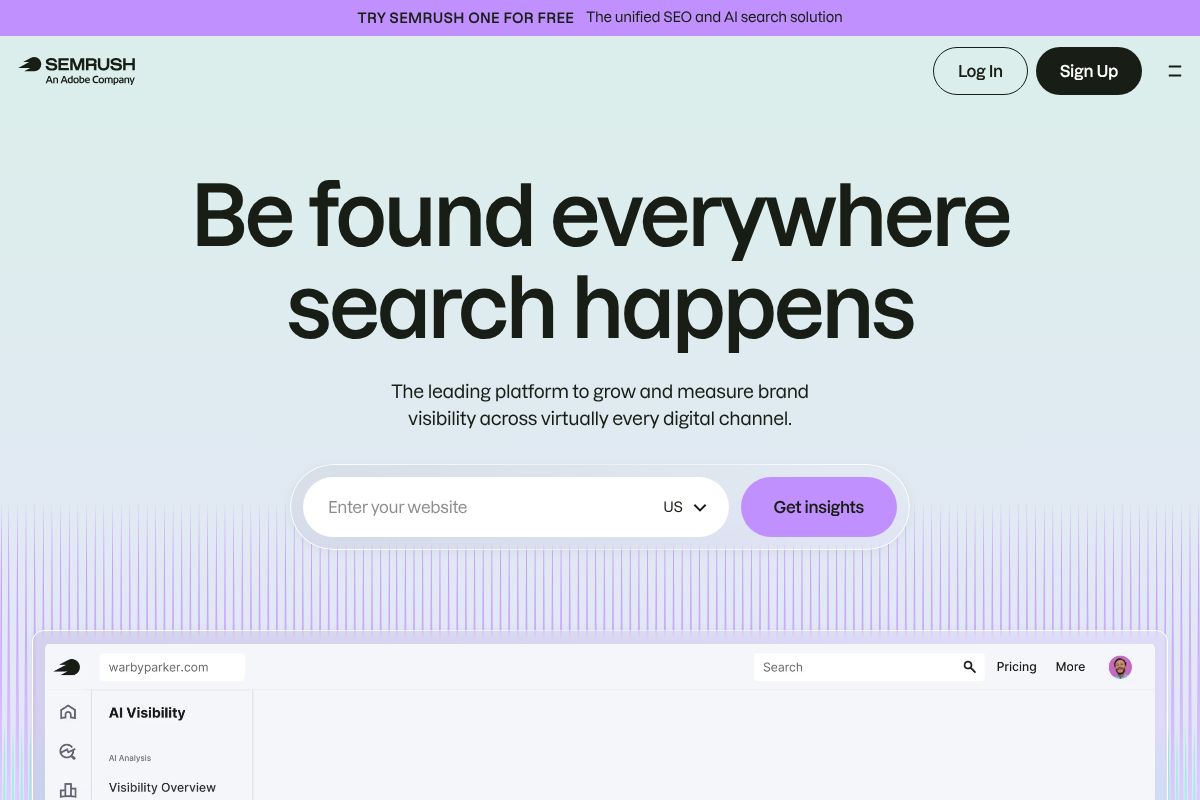
If keyword tools are the entry point, Semrush is where serious SEO work happens. It’s not one feature — it’s a full stack: rank tracking, competitor analysis, content optimization, backlink auditing, and technical site audits, all feeding off the same data set. The 2026 updates leaned hard into AI layering on top of that data, with an AI writing assistant now built directly into the content optimization workflow and smarter, faster gap analysis that used to take separate manual pulls.
What Semrush’s AI Does Better Than Competitors
The standout feature is still competitor gap analysis, and the AI updates made it sharper. If you want to know exactly which keywords your competitor ranks for but you don’t, Semrush’s AI finds those gaps in minutes — not just the keyword list, but a prioritized view based on ranking difficulty and estimated traffic value. That’s the difference between a spreadsheet and an actual action plan.
Rank tracking at scale is another area where it pulls ahead. Agencies managing 15+ client accounts can set automated reports that flag ranking drops before a client notices and asks why. The backlink analysis tool now uses AI to score link opportunities by authority and relevance instead of just raw domain metrics, which cuts down on chasing links that look good on paper but do nothing for rankings. The AI writing assistant, meanwhile, pulls live SERP data into your draft as you write, suggesting subheadings and terms competitors use that you don’t — useful, though it works better as a second pass than a first draft tool.
Pricing and Who It’s Actually For
Semrush’s Pro plan runs $117.33/month on annual billing (higher month-to-month), and yes, that’s steep next to a standalone keyword tool. It’s built for SEO professionals, content marketers running multiple sites, and agencies who need one dashboard instead of five subscriptions. Solopreneurs and small blog owners will likely find it overkill — the learning curve alone takes a few weeks to get comfortable with, and you’re paying for reporting and audit features you may never touch.
But for teams billing clients or managing competitive niches, the ROI math works. One agency account replacing three separate tools at $50-80/month each already pays for itself, before counting the time saved on manual competitor research. Semrush also runs a $200 first-sale affiliate commission for referral partners, a signal of how much value they expect serious users to get out of it.
Surfer SEO: The Writer’s Choice for Real-Time Content Optimization
Semrush tells you what to fix. Surfer SEO sits next to you while you fix it. That distinction matters if your bottleneck isn’t research — it’s actually writing the article and knowing, in the moment, whether it’s optimized enough to compete.
Why Content Creators Prefer Surfer for SEO Writing
Open Surfer’s Content Editor, plug in your target keyword, and it pulls the top-ranking pages for that term into a live SERP comparison panel next to your draft. As you type, a content score updates in real time — word count, keyword density, headings, and related terms all scored against what’s actually ranking, not some generic checklist. There’s no separate “audit after publishing” step.
The learning curve is close to zero. If you can use a word processor, you can use Surfer within twenty minutes. A freelance blogger writing a 1,500-word post for a client can hit a green optimization score before the first draft is even finished, instead of writing blind and running it through a checker afterward. You can publish better-optimized content in the same time it used to take to write without SEO guidance — that’s the actual pitch, and it holds up.
Surfer’s 2026 update sharpened the AI writing suggestions noticeably. The assistant now flags when a suggested term would feel forced in context, rather than just telling you to cram it in for score points — a real fix for the “stuffed content” complaint writers had with earlier versions.
The Content Planner rounds things out, mapping topic clusters so you’re not guessing what to write next. Combined with SERP Analyzer, it’s a tight loop: plan, write, optimize, publish.
Pricing
The Essential plan runs $79/month billed annually, covering 15 content editors a month — plenty for a solo blogger or a content writer juggling two or three client accounts. Surfer also pays a 25% recurring commission to affiliate partners, one of the more generous ongoing structures in this space. For writers who live inside a document more than a dashboard, Surfer is the easier daily habit to keep.
NeuralText: Building SEO Authority Without the Agency Budget
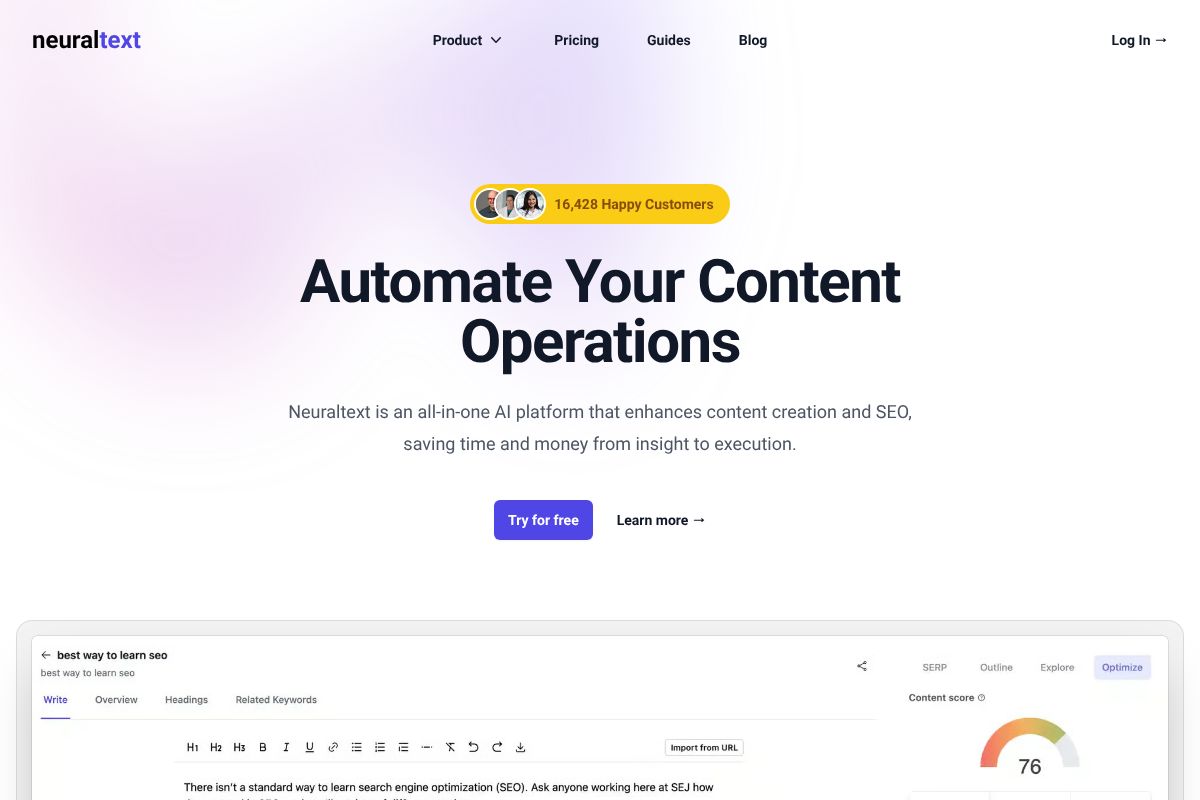
Not every content team has a Surfer or Clearscope-sized budget, and NeuralText is built for exactly that gap. It bundles AI content generation, keyword clustering, content briefs, and bulk optimization into one dashboard, and it does it at a price a solopreneur can justify without a client contract to cover it.
How NeuralText Helps You Build Topical Authority Faster
NeuralText’s clustering engine takes a seed keyword and groups related terms by search intent, then shows you where your existing content has gaps versus what’s actually needed to own a topic. Its 2026 clustering update pulls in fresher SERP data and does a noticeably better job separating informational clusters from transactional ones, so you’re not lumping “best running shoes” and “running shoe size chart” into the same content plan.
The practical use case: a solopreneur running a niche gear review site stops guessing at blog topics and instead gets a content map — twelve interlinked articles instead of one random post a week. Each piece targets a specific cluster gap, and the internal linking suggestions tie them together so the whole group builds authority instead of competing with itself. Instead of writing random blog posts, NeuralText shows you the exact content map to dominate a niche, then generates briefs for each one so writers aren’t starting from a blank page.
Pricing
Plans run from $19/month for a single user with limited credits up to $119/month for teams needing bulk optimization and higher word allowances. NeuralText also offers a 30% recurring affiliate commission, among the highest in this list. For SEO content teams and solo creators scaling a content operation without agency overhead, it’s the most budget-friendly way into serious topical authority work.
Comparing AI SEO Tools: Which One Matches Your Goals and Budget
None of these three tools is objectively “best” — they solve different problems. The right pick depends on how many sites you manage, how often you publish, and how much you’re willing to spend before you see a return.
Semrush vs. Surfer vs. NeuralText: Side-by-Side Breakdown
| Semrush | Surfer | NeuralText | |
|---|---|---|---|
| Best for | Agencies, multi-site owners, competitor tracking | Daily content writers optimizing on-page SEO | Solo creators building topical authority on a budget |
| Starting price | $139.95/month (Pro) | $89/month (Essential) | $19/month |
| Best feature | All-in-one suite: rank tracking, audits, backlink analysis | Real-time content editor with live SEO scoring | Keyword clustering and content mapping |
| Learning curve | Steep — dozens of tools and reports to learn | Moderate — editor is intuitive, but strategy takes practice | Low — clean interface, fast setup |
| Main limitation | Expensive for solo users; overkill if you run one site | Weak on technical SEO and site audits | Thinner feature set outside clustering and briefs |
Semrush costs more but pays for itself if you’re managing three or more sites, tracking competitors, or running client reports. Its price tag doesn’t make sense for a single blogger, though — you’ll pay for tools you never touch.
Surfer is cheaper and faster to learn if you’re a solo writer publishing several posts a week. It won’t help you audit backlinks or fix crawl errors, but that’s not what it’s for.
NeuralText is the budget pick for scaling content without an agency-sized bill. At $19/month, it’s the cheapest way to get a real content strategy instead of guesswork — just don’t expect the depth of a full SEO suite.
Red Flags: What These AI Tools Won’t Do (And What You Still Need)
None of these tools will get you to page one by themselves. Semrush, Surfer SEO, and NeuralText are accelerators — they cut research time and flag gaps you’d otherwise miss. They don’t replace the thinking that makes content worth ranking in the first place.
Here’s what still depends on you:
- Brand voice. An AI-generated brief tells you what topics to cover, not how your company sounds saying it.
- Unique angles. A content score of 85 means you hit the keyword targets your competitors also hit. It says nothing about whether you have a fresh take.
- Editorial judgment. Deciding what to cut, what to lead with, what’s actually true — that’s still a human job.
- Patience. Google can take weeks or months to reward new or updated content, regardless of how clean your optimization score looks.
Take a consultant using Surfer to draft a piece on supply chain software. The editor will tell her to add “inventory management” and “vendor scoring” three or four times each. It won’t tell her to open with the client story that makes the post memorable instead of generic. That’s still on her.
There’s also a floor requirement these tools assume you’ll meet: solid grammar, working links, a site that loads fast, and content that doesn’t read like it was written to hit a keyword quota. Skip those fundamentals and no amount of AI scoring will save you.
Treat these platforms as research and QA assistants, not strategists. The tool can tell you what’s missing. Only you can decide what’s worth saying.
Start Using AI for SEO Today: Your Next Step
You don’t need to commit to a full tech stack this week. Pick one problem — content briefs, technical audits, or keyword research — and test the tool built for it.
Start with a free trial of Semrush or Surfer to see which workflow fits you. Semrush’s 7-day trial gives you the full audit and keyword suite; Surfer’s trial lets you run a handful of content editor scores against pages you’ve already published, so you can judge the recommendations against pieces that already rank.
If you’re on a tight budget, try NeuralText first — it’s the cheapest entry point, and it covers the keyword clustering and brief-building basics without asking you to pay for a dozen features you won’t touch in month one.
A few practical notes before you sign up:
- Most tools offer 7-14 day free trials — put a calendar reminder in for day 6 so you’re not charged for a plan you forgot to cancel.
- Test each tool against a page you already know performs well. If the scoring matches your gut, trust it more on new content.
- Don’t run three trials at once. You’ll end up comparing dashboards instead of learning any single workflow well enough to judge it.
The longer you wait, the more your competitors using AI will pull ahead — not because the tools are magic, but because they’re already a few months into the research-and-refine cycle you haven’t started yet. Your SEO results in 2026 depend on the tools you choose today.
Our Verdict
Editorial rating: 4.6/5
AI transforms SEO execution, not strategy
These tools genuinely accelerate content optimization and competitive research, making professional-grade SEO accessible to smaller teams. The trade-off: AI handles tactics brilliantly but still requires human judgment for strategy, audience understanding, and long-term authority building.
Frequently Asked Questions
Can AI tools actually improve my Google rankings?
Yes, AI SEO tools improve rankings by optimizing content structure, identifying high-intent keywords, and analyzing competitor strategies. However, they work best alongside quality content and legitimate backlinks—AI alone cannot overcome poor site authority or thin content.
Which AI SEO tool is best for beginners?
Surfer SEO is ideal for beginners because it provides real-time content optimization guidance within your editor. It simplifies complex SEO concepts and shows exactly what changes improve ranking potential without requiring advanced technical knowledge.
Is Semrush or Surfer better for SEO?
Semrush excels at competitive analysis and enterprise-level SEO strategy, while Surfer specializes in content optimization. Choose Semrush for comprehensive competitive intelligence; choose Surfer if your primary focus is writing better-ranking content faster.
Do I need to hire an SEO agency if I use AI tools?
Not necessarily. AI tools handle tactical optimization, keyword research, and content analysis that agencies traditionally charge for. However, strategic planning, link building, and technical SEO audits still benefit from human expertise, especially for competitive niches.
Related Reads
- Best AI Tool for SEO in 2026: Top Picks Compared
Find the best AI tool for SEO in 2026. Compare top options for content creators, marketers & small business owners. Hone…
- Best SEO Tools for Small Businesses in 2026
Find the best SEO tool for your small business. Compare top options for content creators, marketers & freelancers with h…
- Best AI Tool for SEO Beginners in 2026
Find the best AI SEO tool for beginners in 2026. Compare features, pricing, and ease of use for content creators and sma…